Telehealth's Hidden Ethics Problem: Confirming Your Client Is Actually Alone
A clinician's guide to securing client privacy in video therapy—environmental checklists, collaborative room checks, and pre-agreed safety signals.
Key takeaway
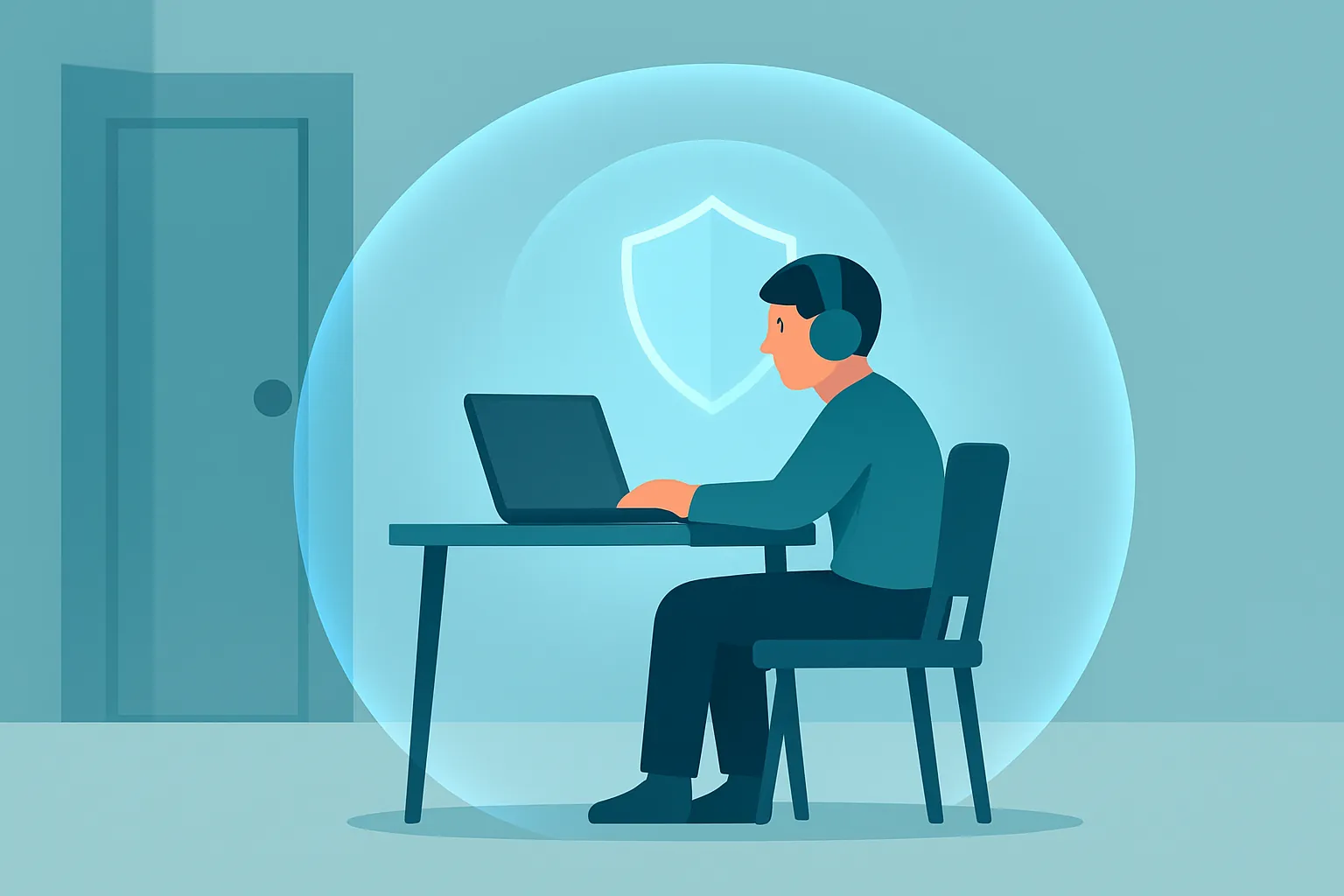
When a client joins a video session without a truly private space, the consequences ripple through the entire treatment: self-disclosure drops, defenses tighten, and the therapeutic alliance weakens—while the ethical burden of confidentiality stays with the clinician. The fix is structural: build an environment checklist into informed consent, run a brief collaborative space-check before each session, and pre-agree on a safety signal for sudden interruptions. To stay present to the client's micro-expressions instead of policing the frame, many clinicians offload documentation to a security-first AI note-taking tool.
The Client on Your Screen: Are They Really Alone?
Since the pandemic, telehealth has shifted from an option to a permanent fixture of clinical practice. But the moment the video window opens, many clinicians feel a familiar flicker of tension. "Sorry, I just stepped into a coffee shop." "My family's in the next room, so I have to keep my voice down." A single sentence like this can quietly reshape the entire session. Once we leave the physically controlled environment of the consulting room, can we still fully protect a client's confidentiality and psychological safety?
Many of us worry about what lies beneath the convenience of remote work: the collapse of structure. When a client hasn't secured a private space, the problem is not merely background noise. It lowers self-disclosure, strengthens defenses, and—over time—erodes the therapeutic alliance. This article looks at why a client's physical space matters so much in telehealth from a clinical standpoint, and offers concrete, ethically grounded ways to help secure it.
What "Space" Means Clinically in a Remote Session—and Why It's Risky
Space as a holding environment
Winnicott's concept of the holding environment assumes the safety of a physical space. In person, the soundproofed walls, the closed door, and the calibrated distance between clinician and client are therapeutic instruments in their own right. In telehealth, that physical boundary shrinks to the edges of a monitor. If a client isn't in a private space, the holding is broken, and they become unconsciously aware of an unseen "censor"—a family member, a roommate, a stranger nearby. That awareness is one of the largest obstacles to free association and to any deep emotional experience.
The confidentiality dilemma and the clinician's expanded responsibility
The APA Ethics Code places client confidentiality at the center of practice. In a remote setting, though, the dilemma is that physical security on the client's end—not just technical security against hacking—falls outside the clinician's direct control. It's tempting to reason, "The client chose the location, so it's their responsibility." But the professional still carries an ethical duty to inform and educate the client in advance about how an unsafe environment can undermine the work.
Environmental control: in-person vs. telehealth
Clinicians need a clear picture of the environmental variables a remote session introduces. The table below compares the factors we can control in each setting—and makes plain what telehealth asks us to verify that an office never did.
| Factor | In-Person | Telehealth |
|---|---|---|
| Physical boundary | Fully controlled by the clinician (soundproofing, locks) | Dependent on the client's environment (family, roommates, public spaces) |
| Interruptions | Minimized (few variables beyond a phone) | Many (deliveries, pets, family entering, unstable Wi-Fi) |
| Nonverbal cues | Full-body observation; subtle tremors easy to catch | Limited to head-and-shoulders on screen; detail lost to resolution |
| Sense of safety | Authority and steadiness conferred by the setting | Blurred boundary as living space and treatment space merge |
Table 1. Environmental control variables in in-person vs. telehealth sessions.
A Practical Guide to Helping Clients Secure a Private Space
So how do we actually help a client create a safe space? "Please log in from somewhere quiet" is not enough. Here are three concrete strategies that complete the ethical setup while minimizing client resistance.
1. Structure it early: give a specific environment checklist
Build the environmental requirements for telehealth into the informed consent stage. Rather than burying them in text, a short visual checklist works better:
- Enclosed space: Is it a room with a door that closes—and ideally locks?
- No one else present: Can you go undisturbed for the full session?
- Audio tools: Earbuds or headphones on, so sound doesn't leak into the room.
- Where not to connect: A moving car, a café, a park, or lying in bed (too relaxed to do the work).
2. Before the session: a collaborative "room scan" and tech check
Early in treatment, or whenever a client seems anxious, you can ask—with their permission—to slowly rotate the laptop or camera so you can see the room. The framing matters: this is not surveillance but a collaborative check, you and the client confirming the space is safe together. Insist gently on headphones or earbuds so household members can't hear your voice. When a client says, "It's fine if my family hears," explain—firmly but warmly—that protecting that boundary is your own ethical principle, not a request.
3. Agree on a safety signal for interruptions
Decide in advance on a signal for moments when a family member walks in unexpectedly or some other interruption breaks the frame. For example: if the client suddenly drops a particular emoji in the chat or turns off their camera, you immediately fall silent and wait. A small agreement like this plants a powerful belief in the client—my clinician will protect me in an awkward moment—and deepens trust.
Staying Present to What Matters
Securing a private space in telehealth is not a matter of etiquette. It is where therapeutic ethics begin, and the last line of defense for a client's psychological safety. We have to actively intervene and educate so clients can build the physical and psychological room to protect themselves. That very act of structuring becomes, for the client, an experience of being respected and protected—which in itself strengthens the work.
In practice, though, there's a real risk: while we're busy managing the environment on the far side of the screen, we miss the subtle shifts in a client's expression or the nuance in their words. Pour energy into tech setup and space checks, and note-taking and analysis are the first things to slip.
This is where a security-first AI documentation and transcription tool becomes a genuinely smart option. With an AI partner that automatically captures the session as text and surfaces key themes, you can set down the burden of writing and stay fully with the client's face and the changing room around them. Remote audio is often relatively clean, so recognition accuracy tends to be high—which dramatically cuts the time it takes to prepare supervision material or consolidate clinical insight afterward. Modalia AI is built for exactly this: a security-first partner for transcription, case conceptualization, and progress notes.
The tools may change, but the essence doesn't. When the ethical sensitivity to secure a safe space meets the flexibility to use new technology well, we can connect with the client on the other side of the screen for real. So before your next telehealth session: is your client's space truly safe?
FAQ
References
- 1.
- 2.
Frequently asked questions
Why does a client's private space matter so much in telehealth?
Without a truly private space, clients stay subtly aware of others nearby, which lowers self-disclosure, strengthens defenses, and weakens the therapeutic alliance. Winnicott's holding environment depends on physical safety, and on screen that boundary shrinks to the edges of a monitor—so the clinician has to help rebuild it.
Whose responsibility is confidentiality when the client chooses the location?
Even though the client picks where they connect, the clinician retains an ethical duty under the APA Ethics Code to inform and educate them in advance about how an unsafe environment can compromise confidentiality and the work. Physical security on the client's end is outside your direct control, but warning about it is not.
How can I check a client's environment without it feeling like surveillance?
Frame it as a collaborative safety check rather than monitoring. Ask permission, then invite the client to slowly pan their camera so you can confirm the space together. Pair it with headphones and a brief checklist, and present these as your shared ethical setup—not a demand.
What is a telehealth safety signal and why use one?
It's a pre-agreed cue—dropping a specific emoji in the chat, or turning off the camera—that tells you a family member has walked in or the frame has been broken, so you immediately fall silent and wait. It reassures the client that you'll protect them in an awkward moment, which deepens trust.
This article was written and reviewed using Modalia AI's clinical guidelines, with professional human review before publication.
Related articles
 Clinical Skills
How to Write Better Supervision Questions: Getting What You Actually Need from Your Supervisor
Stuck on what to ask in supervision? Use these structured question strategies to turn vague check-ins into focused clinical insight.
7 min read Clinical Skills
From "The Client Seems Depressed" to a Clinical Hypothesis: How Word Choice Elevates Your Case Reports
Turn vague observations into precise clinical hypotheses. A practical guide to terminology and sentence formulas that make your case reports read like expert work.
7 min read Clinical Skills
The Wounded Healer Trap: Why "I Want to Heal Myself" Sinks Your Counseling Grad School SOP
Why admissions faculty flinch at "I want to heal my own wounds"—and how to transform personal pain into a research-grade statement of purpose that gets you in.
6 min read