The Therapy Room as Co-Therapist: How Lighting, Seating, and Scent Lower a Client's Defenses
Your therapy room is a silent third presence in the work. Here's how lighting, seating geometry, and scent quietly disarm a client's defenses.
Key takeaway
The physical environment of a therapy room functions as a 'third therapist,' shaping a client's unconscious relaxation and defensiveness before a word is spoken. Cool daylight lighting (6000K+) can elevate arousal and reads as clinical, while warm, indirect lighting (2700–3000K) supports parasympathetic calm. Seating at a 90–120° angle—rather than a confrontational face-to-face desk setup—gives clients an 'escape route' for the gaze and reduces evaluation anxiety. Subtle scents like lavender and bergamot act directly on the limbic system, and sound masking protects privacy so deeper self-disclosure becomes possible.
The Session Begins the Moment the Door Opens
Have you ever had a client tense up before you've said a single word—or, just as tellingly, exhale and say, "It's so calming in here," the instant they step inside? We tend to locate the success or failure of therapy in the verbal exchange: our techniques, our attunement, our capacity for empathy. Those are the core of the work. But the physical environment of the room is a kind of third therapist, and it is already speaking to the client's nervous system before you begin.
Environmental psychology has long held that humans read safety and threat from the spaces they occupy, largely below the level of awareness. So when you find yourself wondering why a particular client seems so guarded, it's worth asking whether the answer lies in your clinical approach at all—or in the fluorescent tube humming over the room. This piece looks at therapeutic environment design through a clinical lens: the concrete, often-overlooked choices that lower defenses and invite the kind of relaxation that real work depends on.
Lighting: The Quiet Lever on a Client's Arousal
Of everything in the room, lighting offers the fastest, most decisive shift in atmosphere. Clinically, we are always modulating a client's arousal level, and light is a direct input. Bright, cool-white fluorescent lighting (daylight color, 6000K and up) tends to raise alertness and can read as cold and procedural—closer to a hospital exam room than a place to be vulnerable. Research on light and the circadian/alerting system (e.g., Cajochen, 2007) links higher-intensity, blue-shifted light to increased alertness and physiological arousal. Warmer, dimmer light does the opposite: it supports a parasympathetic, settling state.
The sweet spot for honest emotional disclosure is neither stark nor gloomy. Use indirect sources and a floor lamp to add depth, and position fixtures so light never points directly into the client's eyes. The table below maps color temperature to its likely clinical effect.
| Light type (color temperature) | Clinical / psychological effect | Recommended use |
|---|---|---|
| Cool white 6000K and up | Heightened focus and alertness; can induce tension; cold, office-like feel | Limit to psychological testing sessions; avoid during therapy proper |
| Neutral white 4000K–5000K | The most natural light; modest energy; supports factual, level-headed conversation without stirring affect | Suits intake interviews and psycho-education sessions |
| Warm white 2700K–3000K | Psychological ease, warmth, a sense of safety; supports parasympathetic activation and inward exploration | Essential for depth work and emotion-focused therapy; best as indirect lighting |
A simple guide: match color temperature (Kelvin) to the purpose of the session.
Seating Geometry: Designing for Connection, Not Authority
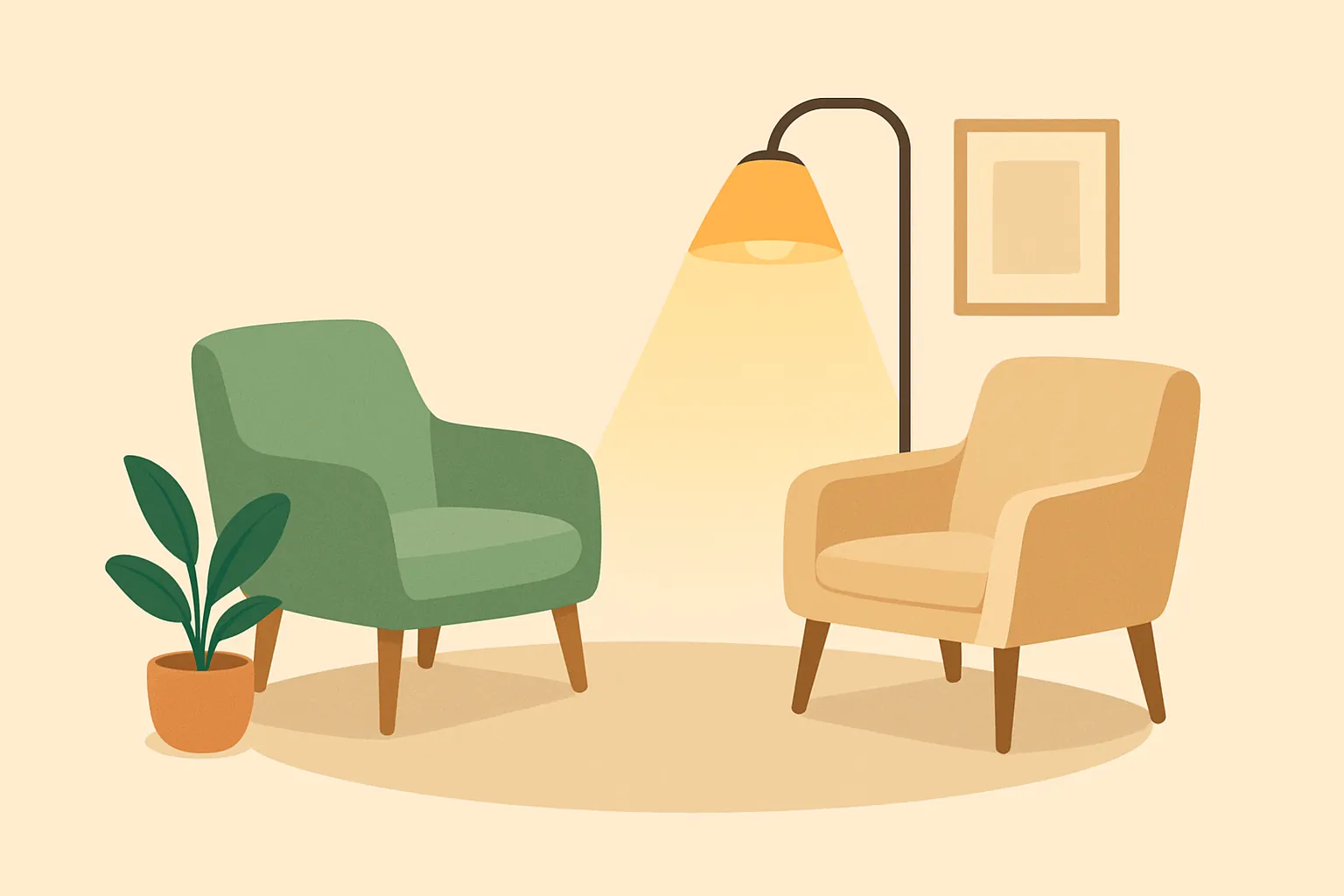
Where the two chairs sit relative to each other shapes the dynamics of the relationship itself. Proxemics—Edward T. Hall's study of how humans use interpersonal space (Hall, 1966)—reminds us that physical distance encodes psychological distance. The arrangement to avoid is the confrontational one: a desk between you, two chairs squarely facing off. It signals authority and sharpens the client's sense of being evaluated.
The ideal is a 90°–120° angle. This lets the client meet your gaze when they want connection and break it naturally when contact feels like too much—an "escape route" for the eyes that quietly lowers evaluation anxiety. The client's chair should also match yours in height and quality, with a back that supports the body firmly. This is the physical expression of what Wilfred Bion called containing: when a person feels physically held and supported, they are more able to feel emotionally held as well. A chair that sits lower than yours, or that offers no support, transmits the opposite message before you've said anything.
Scent and Sound: Reaching the Limbic System Directly
What the eyes take in matters, but so do the nose and the ears. Olfactory signals bypass the thalamus and travel straight to the limbic system, the brain's seat of emotion and memory. In other words, the scent of a room reaches feeling before thought. Heavy perfumes or synthetic air fresheners can trigger headaches and read as artificial; subtle, near-natural aromas—lavender, bergamot, sandalwood—are gentler. Used lightly, they aid grounding and can act as an unconscious anchor: this is a safe place.
Sound does parallel work. White noise or quiet, unobtrusive music masks outside conversation and protects privacy. The moment a client worries their words might leak past the door, deep self-disclosure becomes impossible. A sound-masking device helps seal the room off from the world—closer to a contained, protected space than an exposed one. These sensory considerations are themselves a nonverbal message: they show how carefully you've thought about the client's comfort and dignity.
Beyond the Room: Protecting Your Attention
Suppose you've gotten all of it right—warm light, a supportive chair, a faint trace of lavender. There's one more variable: your own capacity to be fully present in that space. Even a beautifully designed room loses its effect if you break eye contact to write, or puncture a silence with the clatter of typing. Clients register a small rupture every time your gaze drifts to a screen or a notepad.
This is the documentation dilemma, and a growing number of clinicians are addressing it with AI-assisted transcription and note-taking tools—category options include Otter for general transcription and Nuance DAX in clinical settings. By automatically capturing the session and surfacing key content, these tools free you from the administrative weight of writing in real time so you can stay with the client in the here and now. If you go this route, favor a security-first tool with strong confidentiality safeguards—client data is among the most sensitive there is, and tools such as Modalia AI are built around exactly that priority for transcription, case conceptualization, and documentation. Used well, this protects not just the physical environment but your cognitive resources, letting your full attention belong to the person in front of you.
Your Room Is a Secure Base
Interior design, in this context, is not decoration. It is the work of building a physical secure base—Bowlby's term for the safe ground from which a person can risk exploring what frightens them—so that a client feels able to set down their most fragile parts. Take a look around your own room. Is the client's chair lower than yours? Is the light too cold? Does the layout invite connection or enforce distance?
Changing a single lamp, or angling a chair a few degrees, can do more to dissolve a client's defenses than another well-chosen intervention. And in that easier space, you too can set down the burden of note-taking, lean on the tools available to you, and rest your attention more fully on the person across from you. The best design, in the end, is the clinician's undivided presence and an unhurried smile.
References
- 1.
- 2.
- 3.
- 4.
Frequently asked questions
What lighting is best for a therapy room?
Warm white light (2700–3000K), ideally indirect, supports a parasympathetic, settled state and is best for depth and emotion-focused work. Reserve cool white (6000K+) for psychological testing, and use neutral white (4000–5000K) for intake or psycho-education sessions. Avoid pointing any light directly into the client's eyes.
How should I arrange the chairs in a counseling room?
Avoid a confrontational, face-to-face setup with a desk between you, which heightens evaluation anxiety. A 90–120° angle is ideal: it lets clients make eye contact when they want connection and look away naturally when contact feels overwhelming. The client's chair should match yours in height and quality, with a supportive back.
Do scent and sound really affect therapy?
Yes. Olfactory signals reach the limbic system—the brain's emotion and memory center—almost directly, so subtle aromas like lavender or bergamot can foster an unconscious sense of safety. Sound masking or quiet background sound protects privacy; when clients fear being overheard, deep self-disclosure becomes far harder.
How can I take notes without losing connection with the client?
Real-time writing or typing creates small ruptures in contact whenever your gaze leaves the client. Many clinicians now use AI-assisted transcription and documentation tools—choosing a security-first option that protects sensitive client data—so they can stay present in the here and now rather than splitting attention with the record.
This article was written and reviewed using Modalia AI's clinical guidelines, with professional human review before publication.
Related articles
 Clinical Skills
How to Write Better Supervision Questions: Getting What You Actually Need from Your Supervisor
Stuck on what to ask in supervision? Use these structured question strategies to turn vague check-ins into focused clinical insight.
7 min read Clinical Skills
From "The Client Seems Depressed" to a Clinical Hypothesis: How Word Choice Elevates Your Case Reports
Turn vague observations into precise clinical hypotheses. A practical guide to terminology and sentence formulas that make your case reports read like expert work.
7 min read Clinical Skills
The Wounded Healer Trap: Why "I Want to Heal Myself" Sinks Your Counseling Grad School SOP
Why admissions faculty flinch at "I want to heal my own wounds"—and how to transform personal pain into a research-grade statement of purpose that gets you in.
6 min read