Breaking the Silence in Therapy: When to Ask "What Just Crossed Your Mind?"
Silence isn't an absence of words—it's clinical data. Learn to read the three types of therapeutic silence and time your interventions for maximum impact.

Key takeaway
Silence in therapy is not merely the absence of speech but a distinct clinical signal that breaks into three types: processing silence, resistant silence, and blank (dissociative) silence. Each can be distinguished through nonverbal cues such as gaze direction, breathing changes, and postural rigidity, and confusing them can destabilize the working alliance. Psychodynamic, cognitive-behavioral, and person-centered approaches each interpret and respond to silence differently, and integrating these lenses increases clinical flexibility. In practice, nonverbal mirroring, graduated here-and-now questions, meta-communication, and post-session review of silence patterns turn silence into therapeutic momentum.
Is the Silence an Opportunity or a Crisis? Catching the "Golden Moment" to Break In
You close the office door, settle in across from your client, and suddenly ten seconds of silence stretch out between you. For early-career clinicians, those ten seconds can feel like ten minutes—long enough to start an anxious internal monologue. Did I just ask the wrong question? Is the client rejecting me? What am I supposed to say now?
Seasoned clinicians know something different: silence in therapy is not an absence of communication—it can be the most intense communication in the room. Many practitioners struggle with it precisely because the margin for error feels narrow. Break the silence too quickly and you steal the client's chance for insight; let it run too long and you risk leaving the client to drift, or to grow anxious and exposed.
A here-and-now intervention like "What just crossed your mind?" is a powerful tool for surfacing unconscious flow or automatic thoughts. But knowing when to use it draws on a refined clinical sense. This article offers a framework for understanding what silence means and for choosing the most effective moment to step in.
Anatomy of Silence: Why Does a Client Go Quiet?
Effective intervention starts with reading the quality of the silence, because not all silences are alike. Clinically, client silence tends to fall into three types.
- Processing silence. The client is metabolizing what was just said or felt and moving toward insight. This is productive, generative time.
- Resistant silence. Silence as a defense—against hostility toward the clinician, shame, or a secret the client is not ready to reveal.
- Blank silence. A genuinely empty, overwhelmed, or dissociated state in which the client's mind has gone white.
When a clinician confuses resistant silence with processing silence, the working alliance wobbles. Picture a client swallowing tears in deep grief (processing silence). If you ask "What are you thinking?" in that moment, the client may feel their emotion went unrecognized. Conversely, if a client is avoiding a question they would rather not answer (resistant silence) and you simply wait it out, the session stalls.
This is why nonverbal cues matter so much. Gaze direction, shifts in breathing, and postural rigidity act as your navigation system. Eyes that drift and move while staring into space often signal active cognitive processing; crossed arms and averted gaze more often signal resistance. Only once you've read those subtle signals have you earned the right to ask about "the thought that just crossed your mind."
How Each Theory Reads Silence—and Responds
Different theoretical orientations interpret silence in strikingly different ways. Psychodynamic work treats silence as a key marker of transference and resistance; person-centered therapy treats it as time to accept the client's very being; cognitive behavioral therapy (CBT) uses it as a decisive opening to catch automatic thoughts. Clinical flexibility is highest when you can hold more than your primary approach and draw on the others as the moment calls for it.
| Psychodynamic / Analytic | Cognitive Behavioral (CBT) | Person-Centered | |
|---|---|---|---|
| Interpretation of silence | Resistance, transference, expression of repressed needs | Automatic thoughts arising, information processing, cognitive overload | Time for self-exploration; an experience of trust with the clinician |
| Primary goal | Bring unconscious conflict into awareness | Identify irrational beliefs and automatic thoughts | Offer deep empathy, acceptance, and a safe space |
| Suggested prompt | "What were you feeling during that silence?" (transference analysis) | "What was the thought that crossed your mind just before you went quiet?" | (Waiting with a warm gaze) "Right now, I'm here with you." |
| Timing | After resistance recurs or emotion peaks | When facial expression shifts sharply or emotional stirring is visible | Wait until the client breaks the silence or begins to look uncomfortable |
Table 1. Interpretation of silence and intervention strategy across major therapeutic approaches.
Four Practical Ways to Turn Silence into Therapeutic Momentum
So how do you actually work with silence and time your entry in the room? Here are four concrete strategies you can apply immediately.
-
Build a secure base with nonverbal mirroring
Before you ask anything, attune to the client's state. If their breathing slows during the silence, let yours slow to match. If their posture is tense, take a relaxed, settled posture yourself and let that steadiness register. This nonverbal attunement sends the message, "I respect your silence," and lowers the odds of a defensive reaction when you do speak.
-
Apply here-and-now questions in stages
Dropping a blunt "What are you thinking?" into a long silence can feel like an interrogation. Build up to it.
- Step 1 — Observation: "You paused just now and looked out the window for a moment." (fact-based)
- Step 2 — Reflection: "It seems like you've gone somewhere thoughtful—or maybe you're hesitating." (offering a hypothesis)
- Step 3 — Direct question: "In that exact moment, what story were you hearing inside?" (the core question)
This graduated approach gives the client time to prepare to look inward.
-
Use meta-communication
Remember that the silence itself can become the subject of therapy. When a client falls silent repeatedly, address the pattern directly: "It seems like every time we get close to something important, we pause. I wonder what this quiet is doing between us." This reframes silence from an obstacle into something to be explored together.
-
Review session records to analyze patterns
After the session, it's worth reconstructing when the client went silent. Did silence follow specific themes (a parent, an experience of failure)? Did it appear in response to a particular stance of yours? Memory alone is a limited record. Listening back to a recording and matching the length of each silence (in seconds) to the words that immediately preceded it sharpens your sense of timing dramatically.
Conclusion: The Skill of Hearing the Voice Beneath the Silence
Silence in therapy is both a doorway through which the client steps inward and a bridge that tests the trust between you. "What just crossed your mind?" is not a simple question. It's a therapeutic invitation—an attempt to catch the fleeting border between unconscious and conscious and help the client put it into words. When we stop fearing silence and learn to read the dynamics inside it, the work deepens.
Protecting those subtle moments is part of doing high-quality work—yet tracking a client's nonverbal responses, the length of each silence, and the surrounding conversational context all at once, in real time, is nearly impossible. This is where technology can help. Modern AI session-transcription tools go beyond plain text: they can flag silent stretches automatically and analyze turn-taking ratios. Reviewing that data lets you check objectively—Did I cut the silence off too quickly? What had I just said before the client went quiet? As a security-first AI partner built for counselors, Modalia AI supports transcription, case conceptualization, and documentation so you can revisit your own timing with evidence rather than guesswork. When you can see your interventions instead of merely sensing them, a vague "gut feeling" matures into demonstrable clinical expertise. In your next session, when the quiet arrives, try setting urgency aside and knocking gently at the deeper places of your client's mind.
Frequently asked questions
How can I tell the difference between processing silence and resistant silence?
Watch the nonverbal cues. Eyes that drift and move while gazing into space, slowed breathing, and a soft, open posture usually signal active cognitive processing. Crossed arms, averted gaze, and a tense or guarded posture more often signal resistance. When in doubt, mirror the client and wait a beat longer before deciding how to respond.
How long should I let a silence run before breaking it?
There's no fixed number of seconds. The right length depends on the type of silence and the client's state. For processing silence, allowing more time often deepens insight; for resistant or blank silence, a well-timed observation or reflection may be needed sooner. Reviewing recordings and matching silence length to the preceding dialogue is the fastest way to calibrate your own timing.
Is "What just crossed your mind?" appropriate in every approach?
It's most directly associated with CBT, where it surfaces automatic thoughts, but variations work across orientations. Psychodynamic work might ask what the client felt during the silence to explore transference, while person-centered practice may simply stay present and wait. Match the prompt and timing to your goal and the client's readiness.
This article was written and reviewed using Modalia AI's clinical guidelines, with professional human review before publication.
Related articles
 Case Conceptualization
Breaking the "Yes, But" Game: A Transactional Analysis Guide for Therapists
Every suggestion you offer gets met with "Yes, but..." Here's the TA structure behind that stall—and four clinical moves to break it.
7 min read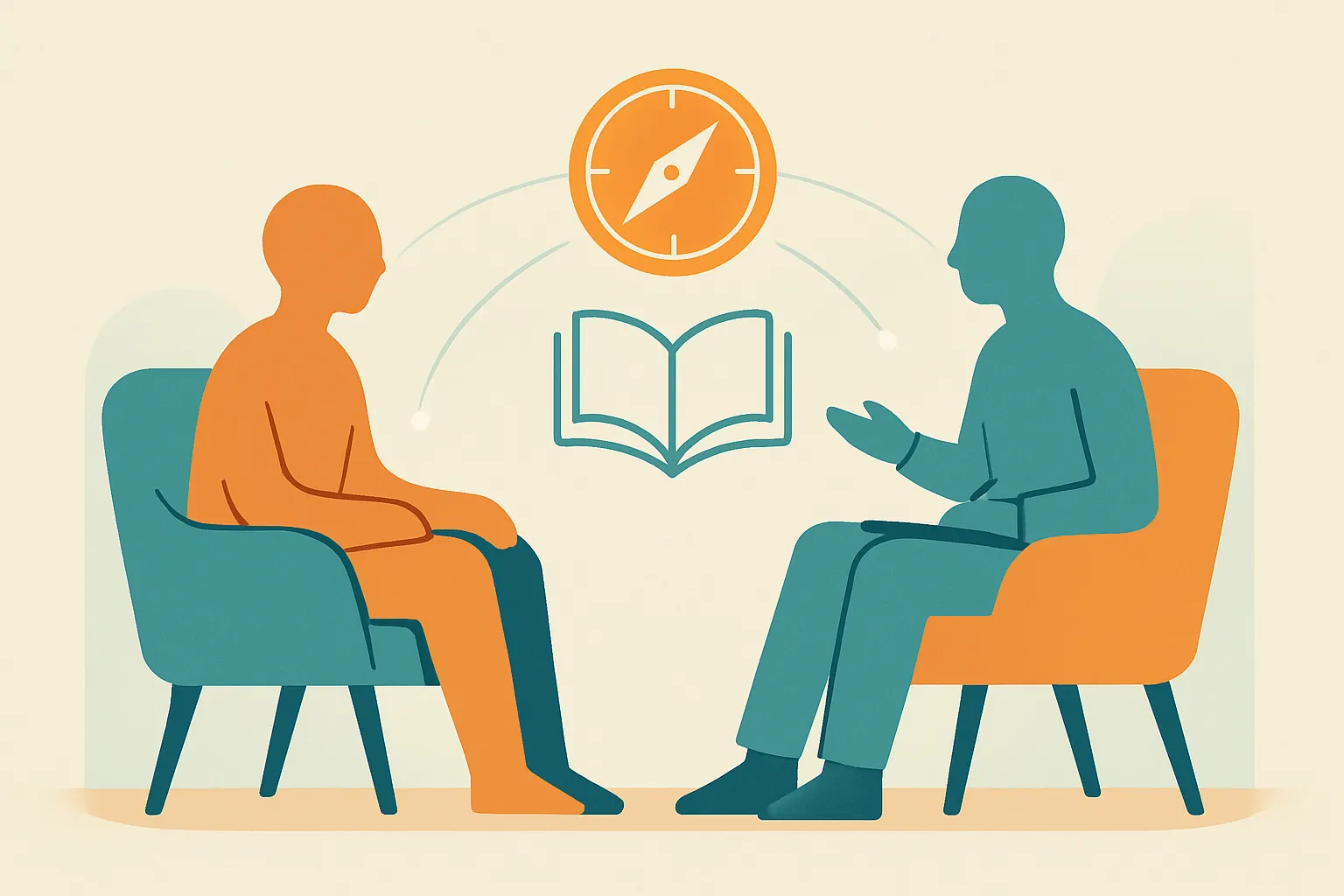 Case Conceptualization
Yalom's The Gift of Therapy: Passages Every New Counselor Should Copy by Hand
Irvin Yalom's prescription for therapists who fear silence: meet your client as a "fellow traveler" and let the here-and-now become the heart of the work.
6 min read Case Conceptualization
Working With Silence in Therapy: What Client Silence Means and How to Hold It
Silence in session isn't empty space. Learn to read its clinical meaning, tell productive from defensive silence, and use it as a therapeutic tool.
6 min read