Holding the Frame: How to Keep Time Boundaries With Clients Who Arrive Late
When a client shows up 20 minutes late, do you extend the hour or hold the line? A clinical guide to structuring, the frame, and what lateness is really telling you.
Key takeaway
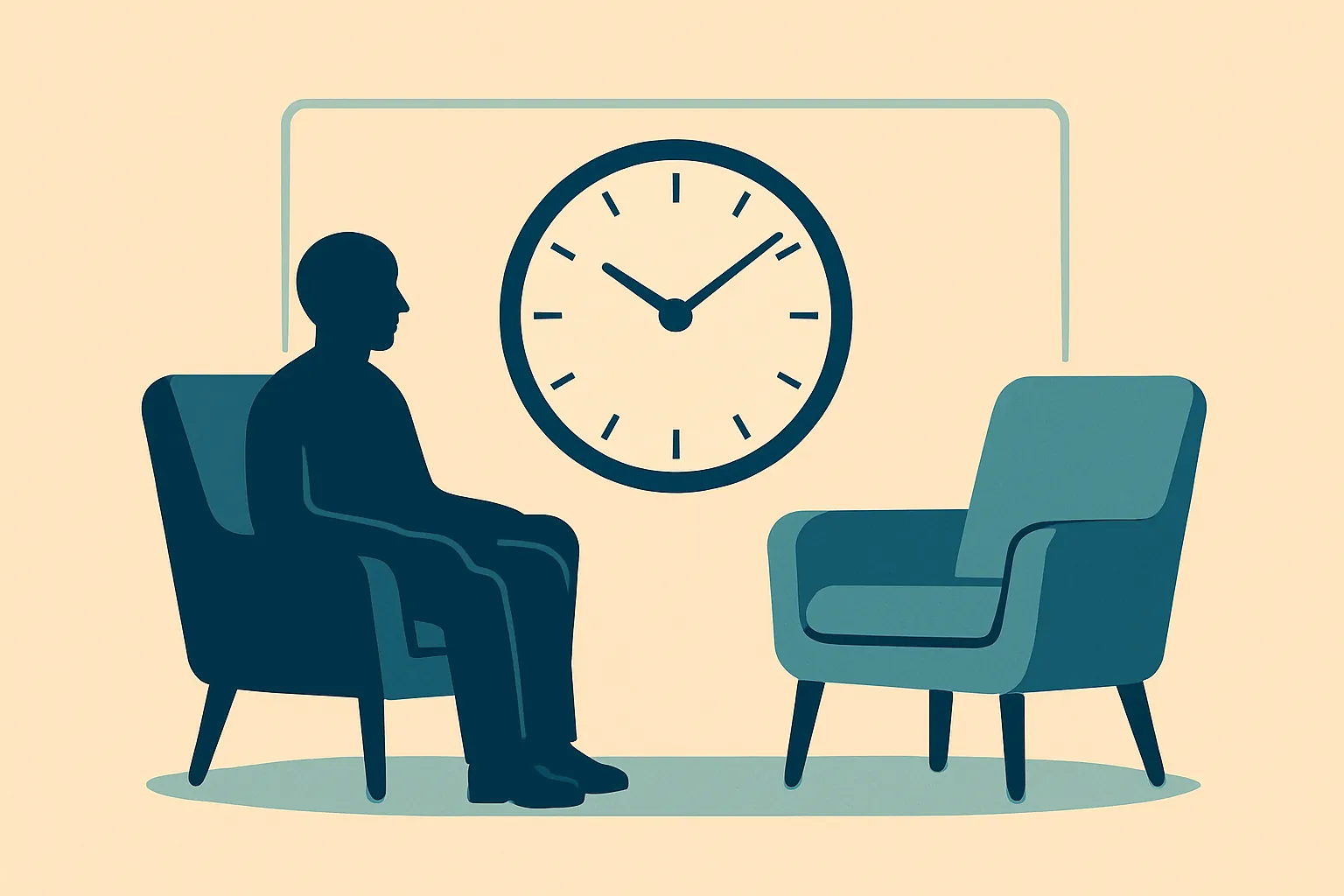
When a client arrives late, the therapist sits with a tangle of feelings—worry, self-doubt, and pressure about the schedule—and faces a dilemma: protect the session's time limit or stretch it for the sake of the alliance. Structuring isn't an administrative rule; it's the therapeutic container that gives clients a sense of safety, and because lateness can express resistance or acting out, extending the hour can quietly collude with that behavior. Giving extra time to one client also fuels burnout and raises a fairness problem that erodes care for the next person. In practice, the work is to name the structure clearly at intake, redirect a late session into here-and-now exploration, and check your own countertransference so the frame stays intact.
Fifteen Minutes, No Knock at the Door: What Comes Up for You?
The clock passes the hour. Five minutes, then ten, then fifteen. There's no text, no call, and the air in the room slowly thickens. Almost every clinician knows this particular silence, and almost every clinician feels it as a tangle rather than a single emotion. There's worry first—Did something happen on the way here? Then quiet self-scrutiny—Did I mishandle something last session? And underneath that, a very practical pressure—If this runs over, my next client's start time is gone.
Then the door finally opens. The client rushes in, twenty minutes late, slightly out of breath: "I'm so sorry, traffic was brutal." And the dilemma lands. Do you hold the time limit and work with the thirty minutes that remain, or do you give a little extra for the sake of rapport?
Structuring is not housekeeping. It is the work of building a container—a holding space that offers the client a sense of psychological safety. But when you're looking into the eyes of someone still catching their breath, it can feel almost cruel to say, evenly, "We have thirty minutes left today." Early-career clinicians in particular often dread this moment, worried the reminder will read as rejection or punishment. This piece is about how to structure time with a chronically late client in a way that is both therapeutic and ethical—and why doing so is one of the more underrated interventions in the room.
The Time Limit Is the Intervention, Not the Rule Around It
The frame as a secure base
Writing on the analytic frame, Robert Langs argued that when the frame is broken, the client's unconscious anxiety rises rather than falls. A fixed session length offers something rare: a constant that does not move with the weather of the client's life. If a client arrives late and you simply extend the hour, they may feel grateful in the moment—but the unconscious message can be "this clinician's boundaries can be pushed," or "the rules bend depending on what I do." Keeping time is not about controlling the client. It is the boundary that safely contains their impulses and confusion.
Reading the resistance and transference inside lateness
Clinically, lateness often means more than traffic. It can be resistance to the work itself, or it can be a form of acting out—a test of how much the clinician will absorb, accommodate, or tolerate. When you respond by extending the time, you risk colluding with the acting out. Ending on schedule does the opposite: it lets the client meet the real, ordinary consequence of the time they lost, and that confrontation with reality is itself therapeutic. The boundary teaches something words can't.
Protecting against burnout is an ethical act
Stretching the hour for a late client costs you your break or your preparation time for the next person. That accumulates as fatigue, and fatigue degrades the quality of care you can offer the client who comes next. There's also a fairness problem: giving one client extra time that others don't get is an equity issue, not just a scheduling one. Protecting yourself is, in a direct sense, protecting your clients.
Flexible in Spirit, Firm in Structure
So how do you actually respond when a client walks in late? The internal stance is receptive; the external posture is structured. You can empathize with what made them late while still making the remaining time unmistakably clear. The table below contrasts a non-therapeutic response with a structuring one.
| Non-therapeutic (blurred boundary) | Therapeutic (frame held) | |
|---|---|---|
| Stance | Apologetic, anxious, or irritated | Calm, neutral, accepting |
| What you say | "Traffic was awful—okay, I'll give you a bit extra today." | "That sounds like a stressful trip. We have twenty-five minutes together today. How do we want to make the most of them?" |
| Ending | Runs 10–20 minutes over | Ends exactly on time; affirms the next session |
| Clinical result | Reinforced sense of entitlement; clinician burnout | Stronger reality-testing; experience of a safe boundary |
Three concrete strategies for working with a client who is regularly late:
1. Re-establish the structure clearly at intake
When you go over the consent and working agreement, name it explicitly: "If you arrive late, the session still ends at our scheduled time—this protects both the quality of your work and the next client's." Then, when the first late arrival happens, restate it gently and without blame: "As we talked about, we'll wrap up at our usual time. Let's use what's left as fully as we can."
2. Pivot into the here and now
Don't let the remaining minutes drain away in a long explanation of why they were late. Move the focus from the external situation (the traffic) to the internal state: "That sounds like a hard way to get here—what's going on for you right now?" That redirection makes even a short session dense and worthwhile.
3. Check your countertransference
If one particular client's lateness leaves you unusually angry—or, conversely, so guilty that you keep extending the hour—suspect countertransference. Ask yourself: Do I need this client to see me as the good, generous one? Am I afraid of their anger if I hold the line? Simply noticing the pull is often enough to restore your footing in the frame.
Turning Clinical Detail Into Growth
Structuring isn't settled in a single announcement; it firms up across the repeated interactions of every session. How a clinician handles a disruption like lateness has real weight in a client's change process. Yet once the session ends and the next client is already arriving, it's easy to lose track of exactly which words you used to name the time limit—or the small shift in the client's expression when you did.
To keep those clinical details from slipping away, a growing number of practitioners lean on AI-assisted documentation and session-transcript tools as a support. When the moment you set the time boundary is captured as text, you can revisit it later in supervision or your own self-review and ask sharper questions: Did my voice waver when I said "we can't"? When the client raised something significant five minutes before the end—the classic "doorknob confession"—did I get flustered and break the structure? Reviewing those moments as objective data, rather than fading memory, is where the learning compounds. (For clinicians, the priority with any such tool is security and confidentiality—Modalia AI is built security-first for exactly this kind of clinical work, from transcription to case conceptualization to documentation.)
In the end, the goal is not perfect control. It's the clinician's steadiness—the effort to keep a therapeutic center even when the situation wobbles. A client's lateness can be a small crisis, but it's also an opening: a chance to let them experience a firm, reliable boundary. So when your next client arrives late, meet them not with alarm but with a warm, steady, unhurried presence. That very steadiness may be the most healing message they receive.
Key Takeaways
- The fixed session length is a therapeutic container, not an administrative rule—holding it offers safety, not punishment.
- Lateness frequently carries resistance or acting out; extending time can quietly collude with it, while ending on schedule supports reality-testing.
- Protecting your own time and energy is an ethical duty, tied directly to fairness and the quality of care for every client.
- Name the structure at intake, redirect late sessions into the here and now, and monitor your countertransference to keep the frame intact.
References
- 1.
Frequently asked questions
Is it ever okay to extend a session when a client arrives late?
As a rule, no. The consistent session length is part of the therapeutic frame, and routinely extending it can blur boundaries, fuel acting out, and erode care for your next client. Rare, clinically justified exceptions exist (for example, an acute safety concern), but they should be deliberate and reflected on—not a habit of accommodation.
How do I tell a chronically late client about the time limit without sounding punitive?
Set the expectation at intake as a protective measure, not a penalty: the session ends on time to safeguard the quality of their work and the next client's care. When lateness happens, restate it calmly and without blame, then pivot immediately to making the remaining time meaningful. A neutral, accepting tone is what keeps it from reading as rejection.
What does it mean if a client is repeatedly late?
Persistent lateness often expresses something beyond logistics—resistance to the work, ambivalence, or a test of how much you'll accommodate. Rather than treating it only as a scheduling problem, bring curiosity to it as clinical material and explore it in the here and now with the client.
How do I know if my reaction to a client's lateness is countertransference?
Watch for reactions that feel disproportionate—unusual anger, or guilt strong enough that you keep extending the hour. Ask whether you need the client to see you as the generous one, or whether you fear their anger. Naming the pull is often enough to restore your steadiness in the frame, and it's worth bringing to supervision.
This article was written and reviewed using Modalia AI's clinical guidelines, with professional human review before publication.
Related articles
 Case Conceptualization
Breaking the "Yes, But" Game: A Transactional Analysis Guide for Therapists
Every suggestion you offer gets met with "Yes, but..." Here's the TA structure behind that stall—and four clinical moves to break it.
7 min read Case Conceptualization
Yalom's The Gift of Therapy: Passages Every New Counselor Should Copy by Hand
Irvin Yalom's prescription for therapists who fear silence: meet your client as a "fellow traveler" and let the here-and-now become the heart of the work.
6 min read Case Conceptualization
Working With Silence in Therapy: What Client Silence Means and How to Hold It
Silence in session isn't empty space. Learn to read its clinical meaning, tell productive from defensive silence, and use it as a therapeutic tool.
6 min read