Do Therapists Fight With Their Spouses? How Clinicians Handle Conflict at Home
How a clinical identity quietly shapes a therapist's marriage—and the concrete, evidence-based ways counselors turn conflict into connection at home.
Key takeaway
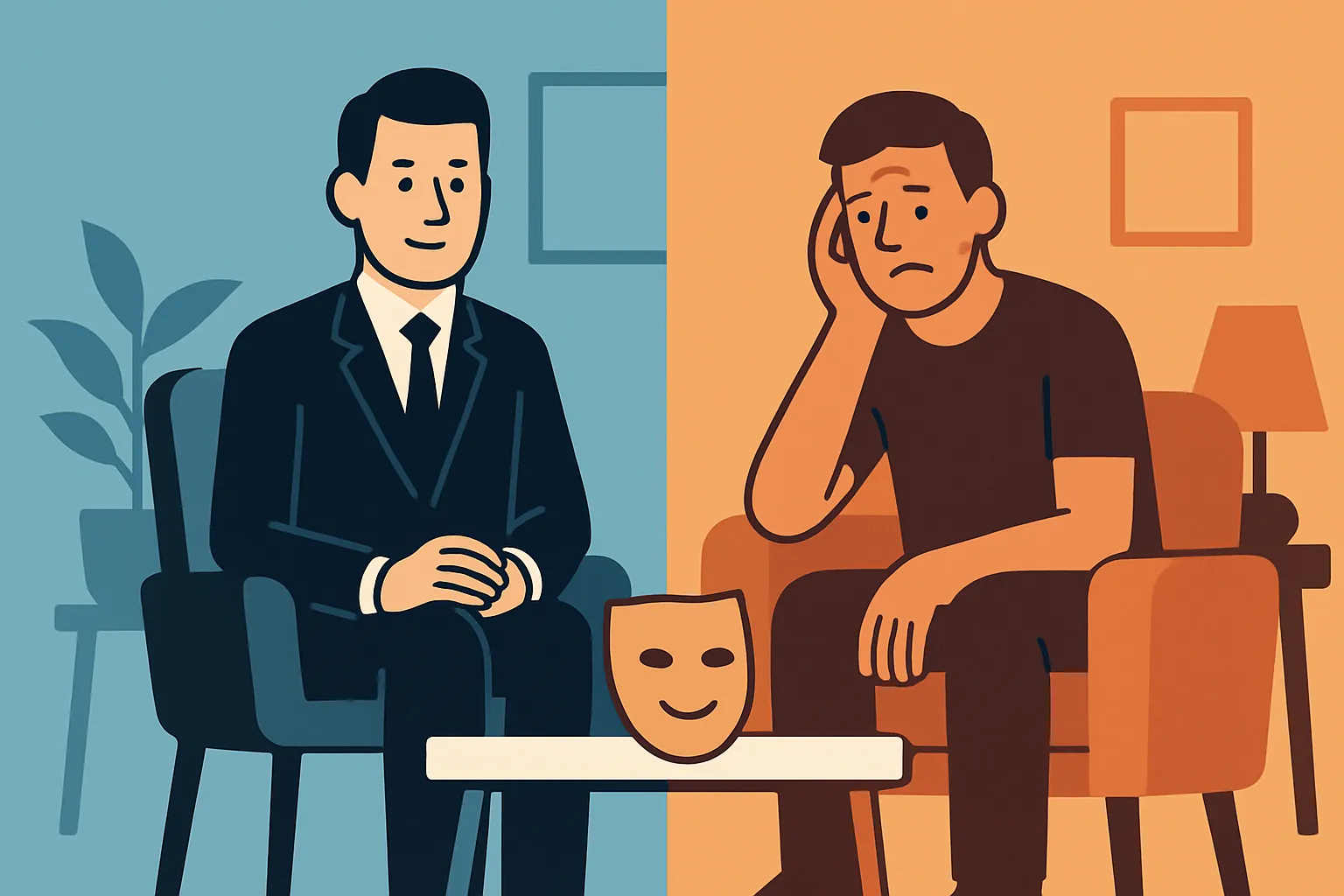
Yes, therapists argue with their partners—and their training can make it harder, not easier. The analytical stance cultivated in session often follows clinicians home, where psychologizing a partner's feelings or diagnosing family-of-origin patterns leaves the spouse feeling unseen rather than understood. Empathy fatigue compounds this: emotional energy spent all day in the consulting room can curdle into coldness at home. The repair isn't avoiding conflict but recovering from it well—using meta-communication, deliberate time-outs and self-soothing, role-transition rituals, and protecting the emotional reserves that documentation and other non-clinical work too easily drain.
"You must never fight with your partner, right?"
Clients often imagine us as serenely regulated beings. "You understand the mind so well—surely you and your partner never argue?" Most of us have fielded some version of that question, and it stirs something complicated. There's a flicker of professional pride, quickly chased by a private wince: last night you and your spouse traded sharp words over who forgot to start the dishwasher. It can feel like a small impostor moment. In the consulting room we hold an empathic, accepting stance for hours. After clocking out, we are simply tired, sometimes prickly human beings.
The truth is that conflict in a clinician's marriage can be more tangled than average—not less. The expertise that helps us professionally can become a liability at home. This piece looks at how a clinical identity cuts both ways in a partnership, and at how we can show up as a healthy spouse rather than an off-duty therapist.
The expert's trap: why a clinician's conflict can run hotter
It's a genuine irony. People who specialize in human psychology and communication sometimes struggle more in their own relationships, largely because we deploy our tools in the wrong context.
The most common pitfall is psychologizing your partner. Instead of receiving a spouse's feelings as they are, we interpret them: "You're only this angry because of your family of origin," or "That's projection." The partner doesn't feel understood—they feel diagnosed, and the anger escalates. Clinically, this is intellectualization: a defense that uses analysis to avoid emotional contact. It keeps us safely in our heads and out of the vulnerable, unflattering middle of the conflict.
A second driver is empathy fatigue. The empathic energy we pour out across a full caseload is finite. When it's spent, what's left for home can look like emotional flatness—a distracted, depleted "mm-hmm" when a partner needs presence. The very capacity that defines our work runs dry exactly when our family draws on it.
Therapeutic stance vs. spousal stance
It helps to name, explicitly, how the posture we take in session differs from the one a marriage actually needs.
| Dimension | Therapeutic stance (in session) | Spousal stance (at home) | What sparks conflict |
|---|---|---|---|
| Purpose of listening | Promote the client's insight and change | Build emotional connection and mutual understanding | Analyzing or trying to "fix" your partner |
| Handling emotion | Contain your own feelings, stay client-centered (manage countertransference) | Share your own feelings honestly | Suppressing, then exploding—or going cold |
| Power structure | A therapeutic hierarchy exists (expert–client) | Horizontal, reciprocal | Lecturing or claiming the superior position |
Table 1. Role differences between the therapeutic relationship and a marriage.
Miss these distinctions and we drift toward one of two extremes: playing therapist in our own kitchen, or going silent and withholding altogether. Worth remembering, too, is John Gottman's research on the "Four Horsemen"—criticism, defensiveness, contempt, and stonewalling. Clinicians are especially prone to the elegantly disguised versions: defensiveness dressed as reasonableness, and contempt wearing the mask of analysis.
Turning clinical skill into a tool for repair, not a weapon
So how do we use our expertise as medicine for the relationship rather than a scalpel against it? The move at the center of all of it is taking off the expert hat and returning to being a vulnerable human being. A few strategies clinicians can actually use:
-
Use meta-communication
We're trained to track not just the content of a conversation but its process. When an argument heats up, that's a real strength: "Right now we're sliding into criticism and defense. Can we pause and each say what we're actually feeling first?" The catch is that meta-communication has to be an invitation to fix our pattern together—not a way to point out what your partner is doing wrong.
-
Make time-outs and self-soothing a ritual
The emotion-regulation skills we teach clients are for us, too. When you're flooded enough that your prefrontal cortex has gone offline, say so concretely: "My amygdala's running the show and I won't say anything good right now—give me 30 minutes to walk, then let's come back to this." That isn't avoidance; it's active protection of the relationship.
-
Build a role-transition ritual
At the front door after work, take a minute of slow breathing—or use the act of changing clothes—to set down the "therapist" self and step into the "partner" self. A small, repeatable boundary like this keeps the day's depletion from bleeding into the evening.
Sustainable practice, a happy home: it comes down to energy
The honest answer to "Do therapists fight with their partners?" is: "Yes—but we try to recover differently." The goal was never a conflict-free marriage. It's resilience: using conflict to understand each other more deeply and repair more quickly. And that depends, more than anything, on managing your own cognitive and emotional energy budget.
Here's where many of us get caught. Hours disappear into administrative work, session transcripts, and case write-ups, so that by the time we get home there's nothing left to give the people we love. Protecting both the quality of our clinical work and the peace of our home starts with making the non-clinical load lighter.
This is one place where security-first AI tools designed for counselors—like Modalia AI, which supports transcription, case conceptualization, and documentation—can function less as a gadget and more as a partner in your quality of life:
- Reclaimed emotional bandwidth. Transcription typically eats two to three times the length of the session. Handing that to a tool gives those hours back—for self-care, or for an actual conversation with your partner.
- Objective self-review. Seeing your talk-time ratio or recurring emotional themes laid out helps you step outside your own patterns and spend clinical energy more deliberately.
- Burnout prevention. Cutting repetitive busywork lowers job strain, and lower strain tends to show up at home as warmer, more positive interaction.
Don't become a lonely spouse in the pursuit of being the perfect clinician. Let smart tools carry the routine load, and spend what's left holding the people you love exactly as they are. Long before we are counselors, we are someone's family—and we have every right to be happy, too.
References
- 1.
Frequently asked questions
Why do therapists sometimes struggle more with conflict in their own marriages?
Because the analytical, containing stance that serves us in session works against us at home. Psychologizing a partner's feelings—naming their projection or family-of-origin patterns—reads as being diagnosed rather than understood. Add empathy fatigue from a full caseload, and there's often little emotional energy left for the relationship.
What is empathy fatigue, and how does it affect home life?
Empathy fatigue (a form of compassion fatigue) is the depletion of the emotional energy we extend to clients all day. When that reserve runs dry, presence at home can flatten into distraction or coldness—not from indifference, but because the very capacity our partner needs has already been spent.
What practical strategies help clinicians manage conflict at home?
Use meta-communication to name the pattern you're both falling into ('we're sliding into criticism—can we pause?'), take deliberate time-outs with self-soothing when flooded, and build a role-transition ritual that helps you set down the therapist self before stepping through the front door.
How does reducing administrative work protect a clinician's relationship?
Non-clinical tasks like transcription and case write-ups can consume two to three times the length of a session, draining the energy you'd otherwise bring home. Streamlining that load—including with AI documentation tools—frees emotional bandwidth and lowers the job strain that often spills into the household.
This article was written and reviewed using Modalia AI's clinical guidelines, with professional human review before publication.
Related articles
 Case Conceptualization
Breaking the "Yes, But" Game: A Transactional Analysis Guide for Therapists
Every suggestion you offer gets met with "Yes, but..." Here's the TA structure behind that stall—and four clinical moves to break it.
7 min read Case Conceptualization
Yalom's The Gift of Therapy: Passages Every New Counselor Should Copy by Hand
Irvin Yalom's prescription for therapists who fear silence: meet your client as a "fellow traveler" and let the here-and-now become the heart of the work.
6 min read Case Conceptualization
Working With Silence in Therapy: What Client Silence Means and How to Hold It
Silence in session isn't empty space. Learn to read its clinical meaning, tell productive from defensive silence, and use it as a therapeutic tool.
6 min read