"But You're a Therapist!" — The Paradox of a Listening Profession and the Clinician's Own Emotional Needs
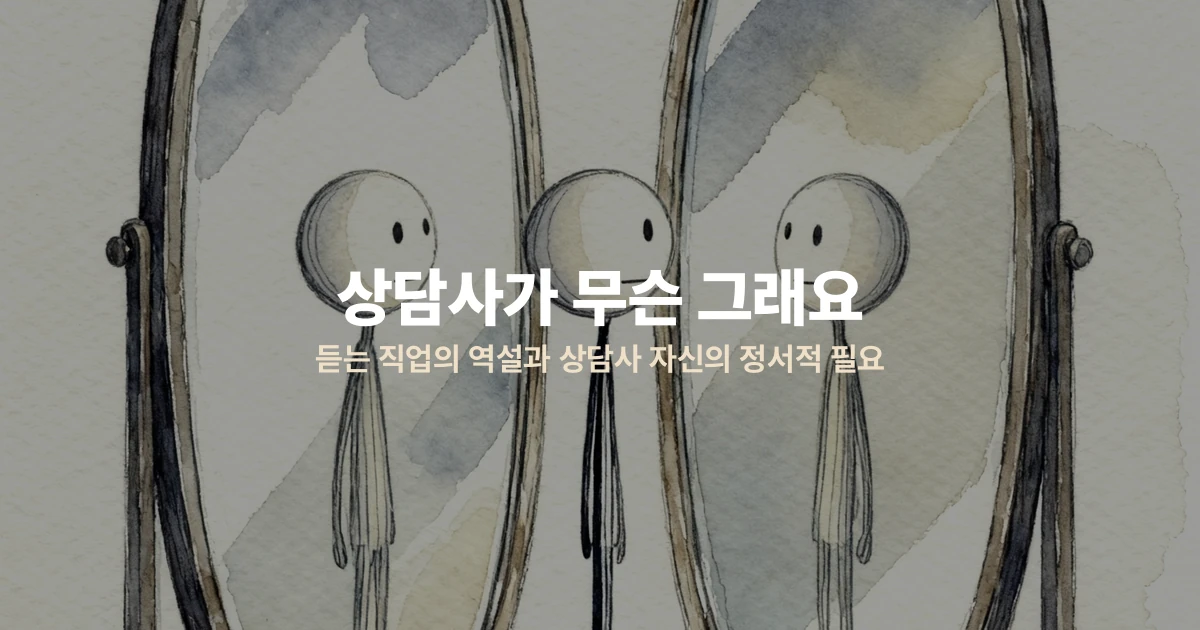
"But you're a therapist!" lands heavily for a clinical reason: it's a double deprivation of social support. Even those who listen all day need to be heard.
Key takeaway
Most clinicians have heard some version of "But you're a therapist — surely you don't struggle with this." The clinical literature explains why that single sentence lands so hard: it functions as a double deprivation of social support, invalidating both the request for help and the person's right to need it. The difficulty isn't personal weakness; it's a structural paradox built into professional socialization. To guard against compassion fatigue (Figley, 2002) and burnout, counselors need three distinct forms of support — peer connection, supervision, and personal therapy — and Norcross and Guy (2007) frame clinician self-care not as indulgence but as a clinical responsibility and ethical imperative.
"But You're a Therapist!" — When the Helper Isn't Allowed to Need Help
You finally open up to a close friend about a hard week, and back comes the line: "But you're a therapist — you of all people should have this figured out." You laugh it off in the moment. Then it sits with you, far longer than it should. If you do this work, you know the comment. And you know the particular loneliness of the night that follows it.
This isn't a matter of one clinician being too sensitive. The clinical literature describes it as a structural paradox embedded in the profession itself — the more your days are spent listening to other people's inner lives, the harder it becomes to ask someone to listen to yours. Left unrecognized and unmanaged, that paradox accelerates emotional depletion and burnout. This article looks at why the comment carries so much weight, and how clinicians can meet their own emotional needs in evidence-based, sustainable ways.
The Paradox of a Listening Profession
The social expectation is unambiguous: "You're an expert in the mind, so surely you manage your own emotions just fine." Clinicians frequently internalize it, too — "I shouldn't be thrown by this. I'm the therapist."
Yet when Skovholt and Trotter-Mathison (2016) studied burnout among practitioners, they found the opposite. People in the caring professions are more likely than the general workforce to override and neglect their own emotional needs, not less. This isn't fragility. It's a pattern laid down during professional socialization.
| The expectation | The reality |
|---|---|
| Therapists handle emotions easily | Caring professionals are more prone to neglecting their own |
| Therapists don't need to lean on anyone | Every human needs social support — clinicians are no exception |
| A struggling therapist should self-manage | Going it alone is a leading risk factor for burnout |
| Struggling signals a lack of competence | Struggling signals that empathic presence is still alive |
Figley (2002) names this paradox as a structural driver of compassion fatigue. Clinicians spend emotional energy every day attuning to others' pain, yet face both internal and external barriers to seeking the social support that would let them refuel.
Why "But You're a Therapist!" Cuts So Deep: A Double Deprivation
The comment stings for a reason more specific than bruised feelings. The literature reads it as a particular failure of social support.
In Cohen and Wills's (1985) foundational work, the most protective form of support is perceived understanding — the felt sense that this person gets me. "But you're a therapist" is the exact inverse: it weaponizes your professional identity to nullify your emotional need.
For a clinician, this is a deprivation on two levels at once. First, you reached out and were turned away. Second, you received the message that your very role disqualifies you from being cared for. That double deprivation is what makes the remark linger.
Norcross and Guy (2007), in their work on therapist self-care, report that one of the most common forms of isolation clinicians describe is precisely this: the sense that non-clinicians can't really understand the work. When that isolation is left to sit — without supervision or peer contact — it speeds the slide toward burnout.
Three Forms of Support That Actually Work for Clinicians
A therapist's emotional needs have a specificity that ordinary social support doesn't fully reach. The literature distinguishes three forms of support suited to the work.
| Type of support | What it involves | Clinical benefit |
|---|---|---|
| Peer support | Mutual support among colleagues in the same field | Eases professional isolation, affirms role |
| Supervision | A professional space for processing clinical difficulty | Works through countertransference, builds competence |
| Personal therapy | The experience of becoming the client yourself | Addresses personal material, deepens self-awareness |
Of these, peer support is the most accessible and the most immediately available. Skovholt and Trotter-Mathison (2016) underscore the maintenance of a peer network as a core protective factor against burnout.
On the night you hear "But you're a therapist" — the most effective response is often a single message to someone who knows the chair you sit in. "A friend said this to me today." That one sentence converts isolation into connection.
A Practical Guide to Meeting Your Own Emotional Needs
Concrete practices for tending to your emotional life as a clinician.
1. Maintain a peer network: people who know the chair
The only people who can fully grasp a clinician's struggles are colleagues in the same work. Staying regularly connected to peers isn't optional — it's a baseline condition for professional longevity. A monthly peer group, a supervision cohort, an informal thread of messages — consistency matters more than format.
2. Talk to non-clinicians: the art of translation
Close family and friends often can't follow the specifics of clinical difficulty. What helps here is translating professional content into emotional experience. Not "I had a hard case today," but "Today was genuinely draining — I'm wrung out." That translation gives a non-clinician something they can empathize with.
Pennebaker's (1997) research shows that putting emotional experience into language is itself a form of processing. Even without expecting full understanding, the act of speaking is therapeutic.
3. Use supervision as a space to process feelings
Supervision isn't only for honing clinical technique. It should be used actively as a place to process your own emotional load in a clinical frame. "Why do I leave so depleted every time I see this client?" — bringing that question into supervision accomplishes countertransference work and self-care at the same time.
4. Personal therapy: the experience of being the client
Many clinicians regard personal therapy as something needed only during training. But in Norcross and Guy's (2007) findings, clinicians with personal-therapy experience report higher compassion satisfaction, lower burnout, and a deeper understanding of the client's experience. Choosing therapy when you need it isn't a deficit in expertise — it's the maturation of it.
| Practice | How | Clinical function |
|---|---|---|
| 1. Peer network | Stay regularly connected to colleagues | Eases isolation, immediate support |
| 2. Emotional translation | Recast professional content as felt experience | Makes connection with non-clinicians possible |
| 3. Using supervision | Process emotional load in a clinical space | Countertransference work + self-care |
| 4. Personal therapy | Become the client when needed | Boosts compassion satisfaction, prevents burnout |
Integrating Professional Identity with Human Need
"But you're a therapist" tries to split your professional identity from your human needs. The literature shows consistently that this split is impossible — and that the harder you attempt it, the more it costs you.
Therapists waver. Therapists feel afraid. Therapists need to be heard. That isn't weakness; it's evidence of being human. And the clinician who meets that human need rather than denying it is — as the research repeatedly shows — the one who can stay with clients longer and go deeper.
Norcross and Guy (2007) frame clinician self-care as an ethical imperative. A therapist who doesn't care for themselves cannot fully care for their clients. Meeting your own emotional needs isn't a selfish choice; it's a clinical responsibility.
The Closest Comfort Comes From Someone Who Knows the Chair
On the night you hear "But you're a therapist" — don't absorb the whole weight of it alone. Send one line to a colleague who does the same work: "Someone said this to me today." The closest comfort comes from someone who knows the chair you sit in.
The more time you spend listening, the less time there is to listen to your own heart — that is the paradox of this profession. To every clinician who knows that paradox and keeps showing up anyway: your heart deserves to be heard, too. That, in the end, is how you keep doing this work for the long haul.
References
- 1.
- 2.
- 3.
- 4.
- 5.
Frequently asked questions
Why does "But you're a therapist" affect clinicians so strongly?
Because it functions as a double deprivation of social support: the request for help is turned away, and the person's professional identity is used to imply they don't deserve care. Cohen and Wills (1985) show that perceived understanding is the most protective form of support, and this remark is its exact inverse — which is why it lingers.
Is needing emotional support a sign that I'm not a competent therapist?
No. Skovholt and Trotter-Mathison (2016) found that caring professionals are more prone to neglecting their own needs, not less — a pattern formed in professional socialization, not a personal flaw. Struggling is a sign that empathic presence is still alive, and meeting that need is what sustains long-term clinical work.
What forms of support work best for counselors specifically?
The literature distinguishes three: peer support (mutual connection with colleagues), supervision (processing clinical difficulty and countertransference), and personal therapy (the experience of becoming the client). Peer support is the most accessible and immediate, and maintaining a peer network is a core protective factor against burnout.
Is personal therapy only for trainees?
No. Norcross and Guy (2007) found that clinicians with personal-therapy experience report higher compassion satisfaction, lower burnout, and deeper understanding of the client's experience. Choosing therapy when you need it reflects the maturation of expertise, not a deficit in it.
This article was written and reviewed using Modalia AI's clinical guidelines, with professional human review before publication.
Related articles
 Case Conceptualization
Breaking the "Yes, But" Game: A Transactional Analysis Guide for Therapists
Every suggestion you offer gets met with "Yes, but..." Here's the TA structure behind that stall—and four clinical moves to break it.
7 min read Case Conceptualization
Yalom's The Gift of Therapy: Passages Every New Counselor Should Copy by Hand
Irvin Yalom's prescription for therapists who fear silence: meet your client as a "fellow traveler" and let the here-and-now become the heart of the work.
6 min read Case Conceptualization
Working With Silence in Therapy: What Client Silence Means and How to Hold It
Silence in session isn't empty space. Learn to read its clinical meaning, tell productive from defensive silence, and use it as a therapeutic tool.
6 min read