Protecting Your Voice as a Therapist: A Vocal-Health Survival Guide for Counselors Who Talk All Day
Your voice is an instrument of empathy—but is it holding up? A clinician's self-check and practical guide to protecting your vocal cords across a full caseload.
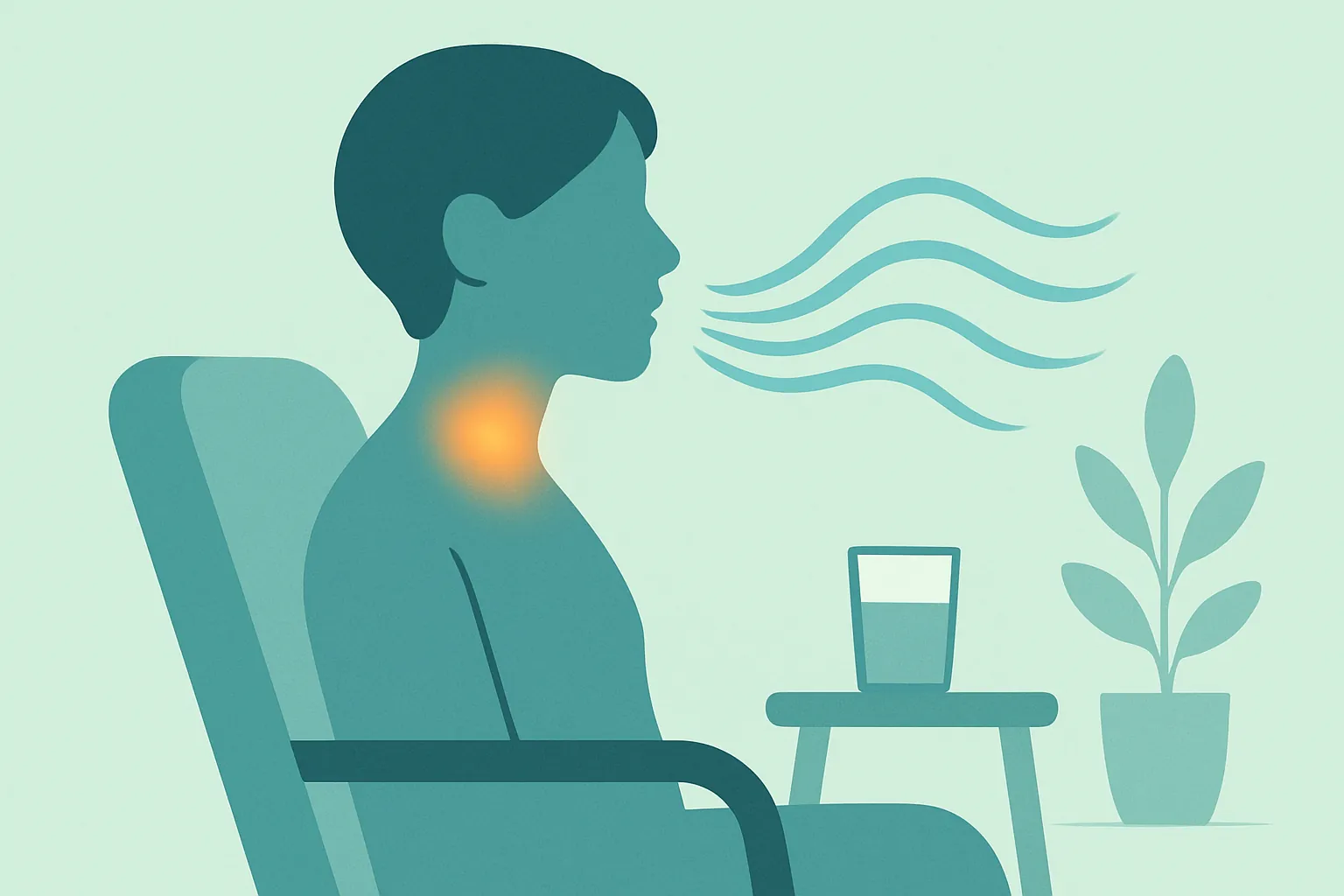
Key takeaway
Therapists speak almost continuously across back-to-back sessions, yet the soft, lowered, intimate vocal style the consulting room invites can actually overload the laryngeal muscles and contribute to muscle tension dysphonia. Shallow breathing in the face of intense client affect, plus dry, sealed office air, compounds vocal fatigue. To protect your voice, build in deliberate therapeutic silences for micro-rest, hydrate about 20 minutes before sessions with room-temperature water, and practice straw-phonation (SOVT) exercises for a few minutes a day. Hoarseness or pain on phonation lasting more than two weeks warrants an ENT evaluation.
Your Voice Is an Instrument of Empathy—Is It Holding Up?
Most conversations about clinical skill focus on technique, theory, or the inner life of the therapist. This one is about something more basic and more easily neglected: your voice. Across an average day of five or six clients—often more—we speak, reflect, attune, and hold, almost without pause. If you have ever finished a day with a raw throat, or felt a powerful "need for silence" that lasted all weekend, your vocal cords are already sending you a message.
For a clinician, the voice is far more than a delivery system for words. It is a primary mechanism for building the therapeutic alliance. Winnicott's concept of the holding environment begins not only with the physical room but with the steady, regulated tone of the therapist's voice. A hoarse, cracking, or strained voice can register as unconscious instability for a client and quietly erode the quality of the work. Yet because our attention is fixed on the client's pain, we rarely hear the strain in our own instrument.
This guide looks at the often-overlooked risk of vocal fatigue in counselors and offers concrete, schedule-friendly ways to protect your voice. A healthy voice supports healthy clinical work.
Why Therapists Fatigue Differently From Other "Talking Professions"
When we picture occupations that involve constant talking, we usually think of teachers or call-center staff. But the therapist's vocal environment has distinctive features—chiefly restrained phonation and continuous emotional tuning.
The paradox of the soft voice
The consulting room is typically quiet and intimate. To match and contain a client's affect, therapists often speak in a tone that is lower, softer, or more hushed than their natural register. Acoustically, this works against us: whispering or artificially lowering the voice increases tension in the laryngeal muscles rather than reducing effort. Sustained over a full day, this dries the vocal folds and is a recognized contributor to muscle tension dysphonia.
Emotional labor and disordered breathing
When we sit with a client's trauma or intense affect, we often—without noticing—hold our breath or shift into shallow, upper-chest breathing. It is one of the ways countertransference shows up in the body. Speaking while under-breathed forces the muscles around the throat to squeeze and compensate for insufficient airflow, accelerating vocal strain.
A dry, sealed environment
Closed consulting rooms, sound-dampened walls that limit air exchange, and running air conditioning or heating all dry out the mucosa of the vocal folds. Phonating with dry folds is, in effect, like rubbing two dry surfaces together—a low-grade abrasion repeated thousands of times a day.
Taken together, these factors point to an important reframe: it is usually not talking a lot that injures the voice, but talking in a strained way and from a tense body. So how safe is your voice right now? Use the self-check below.
Table 1. Vocal-health self-check: temporary fatigue vs. signs that need evaluation
| Domain | Temporary vocal fatigue (manageable) | Concerning sign (seek evaluation) |
|---|---|---|
| Duration | Recovers after a day of rest | Hoarseness persisting two weeks or more |
| Discomfort | Throat feels slightly scratchy or dry | Pain on speaking, or a sensation of a lump in the throat (globus sensation) |
| Pitch range | High notes feel effortful but possible | Certain pitches produce no sound, or the voice breaks unpredictably |
| During sessions | Sipping water temporarily helps | Voice fades sharply as afternoon sessions progress |
Note on terminology: "globus sensation" (the feeling of a lump in the throat) is the phrasing most readily understood by clients and most common in current English-language clinical writing; globus pharyngeus remains the formal medical term.
Practical Vocal-Protection Strategies for Working Clinicians
Taking weeks off or scheduling vocal-fold surgery is rarely realistic on a full caseload. The answer is prevention woven into the daily routine.
1. Use therapeutic silence on purpose
Earlier-career clinicians often struggle to tolerate silence and fill it with unnecessary verbal fillers or extra questions. But silence is a powerful intervention—it gives the client room for insight. Deliberately increasing the frequency of silence serves the client's growth and hands your voice a series of valuable micro-rests. Five minutes of silence within a 50-minute session, repeated across a day, can add up to roughly half an hour of vocal rest.
2. Hydrate at the right time: before and after, not just during
Drinking water mid-session helps, but it takes time for hydration to reach and benefit the vocal-fold mucosa.
- About 20 minutes before a session: drink a glass of room-temperature water to establish whole-body hydration.
- During the session: sip small amounts to keep the throat moist before it feels dry.
- Limit caffeine: coffee and tea are mildly diuretic and dry the folds further. A caffeine-free herbal tea before sessions is a better choice.
3. Make straw phonation (an SOVT exercise) a habit
The single most effective "vocal massage" you can do in a short break between clients is straw phonation:
- Place a straw into a bottle of water and hum a steady "ooo" to make the water bubble.
- This is a form of SOVT (Semi-Occluded Vocal Tract) training. It reduces the collision forces on the vocal folds and helps rebalance the laryngeal muscles. A few minutes a day can meaningfully reduce throat fatigue.
Sustainable Practice: Reducing Your Total Speaking Load
Ultimately, the key is to minimize voice use beyond the speaking that is clinically essential. Beyond sessions themselves, we process language constantly—supervision, case conferences, and the heavy demands of clinical documentation and session transcripts. The habit of talking through a session to reconstruct it, dictating notes, or muttering along while replaying a recording places an invisible extra load on the voice.
This is where leaning on modern tools can be a genuinely wise choice. Increasingly, clinicians are adopting secure, AI-assisted documentation and transcription support to handle the non-clinical talking that quietly accumulates.
Less non-clinical phonation
Instead of switching on a recorder after a session and narrating your recollections to organize them, accurate transcription support can absorb that work—pushing the time you spend "using your voice for the record" toward zero.
Cleaner data, more psychological room
When the burden of typing or dictation lifts, you can devote your full attention to the client's nonverbal cues and to analyzing countertransference. That conserves your energy and lets you arrive at the next session with a clearer, more resonant voice.
A therapist's voice is like a hand that soothes the client's mind. To keep that hand from going rough, start today—with a glass of water, a few more moments of silence, and a more efficient approach to documentation. Your healthy voice is part of your client's healing.
- 🚿 Action item 1: Put a glass of room-temperature water on your desk right now.
- 🤫 Action item 2: In your next session, consciously wait three extra seconds before breaking a silence.
- 🎙️ Action item 3: Consider whether a secure AI documentation tool—like Modalia AI—could reduce your repetitive administrative and transcription burden.
Modalia AI is a security-first AI partner for counselors, supporting transcription, case conceptualization, and documentation so you can spend less of your voice—and your energy—on paperwork.
References
- 1.
- 2.
- 3.
Frequently asked questions
Why do therapists strain their voices even though they speak softly?
Speaking softly or in an artificially lowered, hushed register actually increases tension in the laryngeal muscles rather than reducing effort. Combined with shallow breathing during emotionally intense moments and dry consulting-room air, this restrained phonation can contribute to muscle tension dysphonia and chronic vocal fatigue.
What is an SOVT exercise and how do I do one between sessions?
SOVT stands for Semi-Occluded Vocal Tract. The simplest version is straw phonation: put a straw in a bottle of water and hum a steady 'ooo' so the water bubbles. This lowers the collision forces on the vocal folds and helps rebalance the laryngeal muscles. A few minutes a day can noticeably reduce throat fatigue.
When should vocal symptoms prompt a medical evaluation?
Seek an ENT or voice specialist if hoarseness persists for two weeks or more, if you have pain on speaking or a persistent sensation of a lump in the throat (globus sensation), if certain pitches produce no sound, or if your voice fades sharply as the day goes on.
How does reducing documentation help protect my voice?
A surprising amount of vocal load is non-clinical—dictating notes, narrating recollections to reconstruct a session, or muttering along to recordings. Using secure AI-assisted transcription and documentation lets you offload that work, conserving your voice and freeing attention for nonverbal cues and countertransference.
This article was written and reviewed using Modalia AI's clinical guidelines, with professional human review before publication.
Related articles
 Case Conceptualization
Breaking the "Yes, But" Game: A Transactional Analysis Guide for Therapists
Every suggestion you offer gets met with "Yes, but..." Here's the TA structure behind that stall—and four clinical moves to break it.
7 min read Case Conceptualization
Yalom's The Gift of Therapy: Passages Every New Counselor Should Copy by Hand
Irvin Yalom's prescription for therapists who fear silence: meet your client as a "fellow traveler" and let the here-and-now become the heart of the work.
6 min read Case Conceptualization
Working With Silence in Therapy: What Client Silence Means and How to Hold It
Silence in session isn't empty space. Learn to read its clinical meaning, tell productive from defensive silence, and use it as a therapeutic tool.
6 min read