Designing a Therapy Office That Helps Clients Feel Safe: Environmental Psychology for Clinicians
How lighting, color, seating angles, and biophilic design shape your client's nervous system—and the rapport you build—from the moment they walk in.
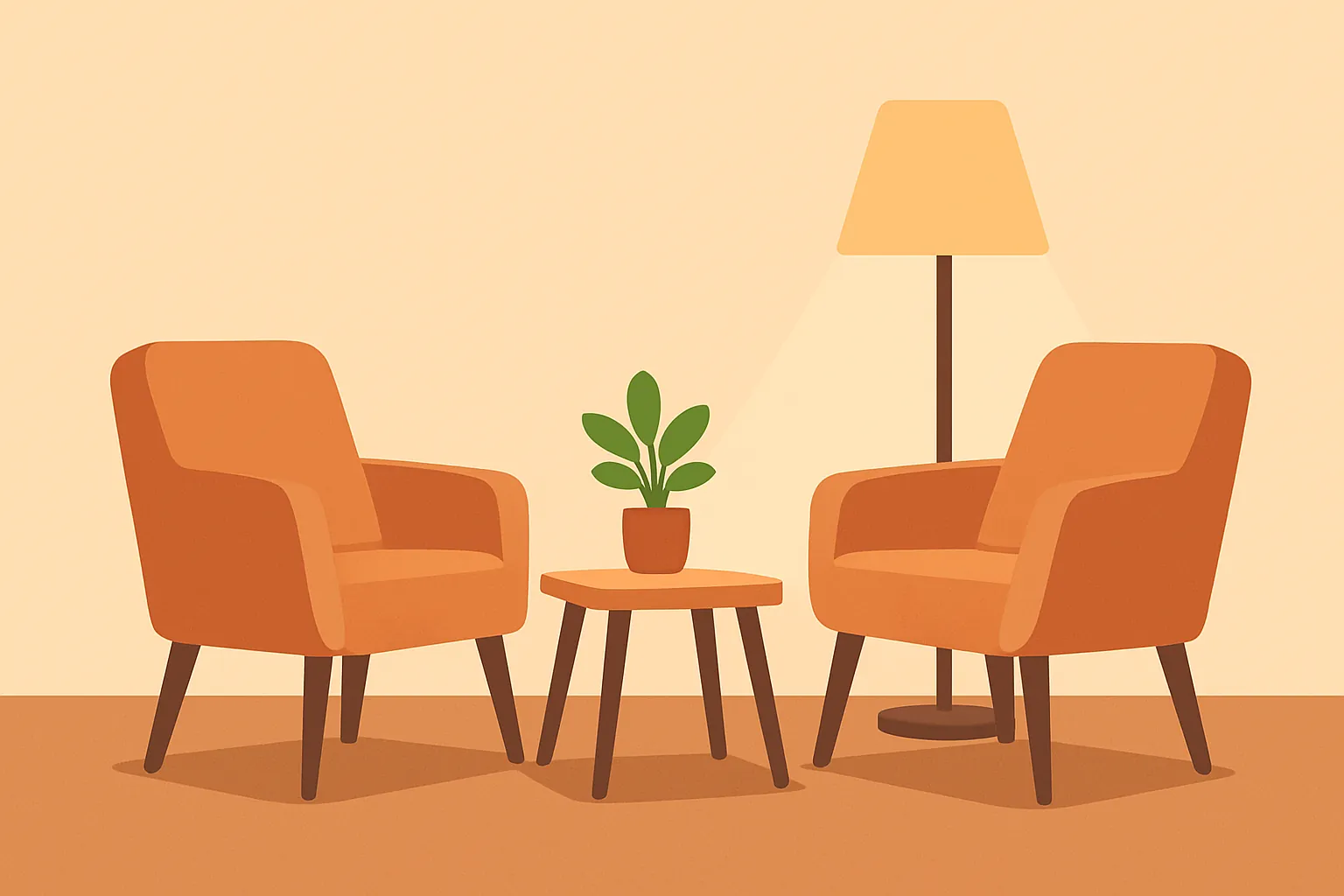
Key takeaway
A counseling room's physical environment acts directly on a client's autonomic nervous system, making it a quiet but powerful variable in early rapport and the therapeutic alliance. Warm lighting in the 3000K–4000K range supports parasympathetic activation, while neutral, nature-inspired tones create a receptive atmosphere. Seating placed at a 90–120 degree angle reduces the pressure of direct eye contact and encourages self-disclosure, and plants and natural materials measurably lower anxiety. Finally, an environment that frees the clinician from the burden of note-taking—so attention stays fully on the client—is just as decisive in shaping a healing space.
Can the Chair Itself Break a Client's Silence? The Quiet Power of Space in the Therapeutic Alliance
Have you ever noticed a client's expression shift—subtly, almost imperceptibly—in the first seconds after they open your office door? We tend to assume that the success of therapy rests on our verbal interventions, our capacity for empathy, and our choice of technique. That is, of course, enduringly true. But how often do we consider that the space itself functions as a kind of third clinician in the room?
In practice, we hear it from clients all the time: "Something about being here just settles me." And we see the opposite, too—a client who tenses or turns guarded the moment they cross the threshold. From the perspective of environmental psychology, the physical environment registers immediately in the client's autonomic nervous system, and that response becomes a decisive variable in early rapport and the therapeutic alliance. For clients carrying trauma or high baseline anxiety, the room's light level, its furniture, even its smell, all serve as cues for a single underlying question: Am I safe here?
As clinicians, we return again and again to a familiar problem: How do I help this person lower their guard and bring forward what lives deepest in them? This article goes beyond décor tips to examine, from a clinical lens, the environmental-psychology principles and concrete design choices that maximize a client's sense of safety and strengthen the work you do together.
1. Light and Color: The First Stimulus That Tunes the Nervous System
The first thing a client encounters on entering is visual information. Roger Ulrich's stress-recovery theory holds that appropriate natural elements and restorative visual environments lower cortisol and support psychological relaxation. Clinically, this means we can use light and color strategically to modulate a client's arousal level.
Color Temperature and Illuminance
Cold white light—fluorescent fixtures at roughly 6000K and above—raises arousal and can prime tension. By contrast, warm-white lighting in the 3000K–4000K range supports parasympathetic activation and a felt sense of calm. This matters most in trauma-focused or emotion-focused work, where indirect lighting reduces eye fatigue and helps create the cocooning, cave-like quality of a true holding environment.
Applied Color Psychology
The colors on your walls and furniture shape a client's affect below the level of awareness. Blues and greens tend to lower blood pressure and invite settling, while an excess of red or saturated yellow can amplify anxiety. The research points toward nature-evoking neutrals—warm beige, soft olive-green, warm gray—as the most reliably neutral yet receptive palette for a counseling space.
2. Furniture and Proxemics: Structuring for Connection, Not Authority
Edward T. Hall's work on proxemics established that the distance between people encodes the nature of their relationship. In a counseling room, the arrangement of furniture shapes the dynamic between clinician and client. Whether a client experiences you as an evaluating authority or as a companion in the work begins with where the chairs sit.
Psychological effects of common seating arrangements
| Arrangement | Structure | Psychological effect (pros / cons) | Best suited to |
|---|---|---|---|
| Face-to-face (across a desk) | Two parties facing each other with a desk between | Pro: formal, professional tone. Con: can read as confrontational; may reinforce a client's defenses | Psychological testing, intake interviews |
| Angled (90°–120°) | Clinician and client seated at an oblique angle | Pro: gaze can break away freely, lowering felt pressure. Con: requires more floor space | Anxiety presentations, social avoidance, most general counseling |
| Open (no barrier) | Chairs only, nothing between | Pro: maximizes closeness; easy to read nonverbal cues. Con: client may feel over-exposed | Longer-term work, clients with established rapport |
As the table suggests, a 90- to 120-degree angle gives the client a "visual escape"—a natural place to direct their eyes when meeting yours feels like too much. That small affordance lowers psychological pressure and reliably supports self-disclosure. It's also worth checking that your own chair isn't noticeably larger or higher than the client's; a level, horizontal relationship should be visible in the furniture itself.
3. Biophilic Design: The Restorative Pull of the Natural World
One of the clearer trends in contemporary clinic design is biophilic design—building the human instinct to return to nature into the space through living plants, wood-grain furniture, natural-light framing, and imagery of landscapes. Studies suggest that the presence of indoor plants is associated with a meaningful drop in client anxiety and a rise in perceived trust toward the clinician.
Living Plants
Place low-maintenance foliage plants in a corner or on a side table. Beyond easing visual fatigue, the green of living things turns the room into a space with vitality—quietly carrying a metaphor of growth and change that the client may absorb without ever naming it.
Texture and Sound
Favor fabric and solid-wood furniture over hard plastic; tactile warmth communicates safety. Equally essential is soundproofing. The moment a client suspects their privacy isn't protected, the conversation closes. Where full isolation isn't possible, a white-noise machine or low ambient nature sound can mask intrusion from outside.
4. Optimizing the "Invisible Environment": Clinician Attention and Documentation
Just as important as the physical room is the ordering of its psychological environment. No matter how warm the space, a clinician buried in note-taking—eyes off the client, visibly anxious about missing something—transmits that anxiety straight across the room. A genuinely safe space is completed only when the clinician's attention rests fully on the client.
The Documentation Dilemma—and How Technology Helps
Many clinicians lose the here-and-now of the interaction to the demands of writing a transcript or jotting notes mid-session. The scratch of a pen or the clatter of a keyboard can become noise that intrudes on a therapeutic silence.
To address this, a growing number of practices are adopting AI-assisted documentation and analysis tools. Technology that automatically transcribes a session and surfaces its emotional core lifts the administrative cognitive load of record-keeping, opening up the psychological room a clinician needs to attend—fully—to a client's face and nonverbal signals. This is one of the surest ways to improve the qualitative environment of therapy, well beyond what physical décor can do.
This is precisely the role Modalia AI is built for. As a security-first AI partner for counselors, it handles transcription, case conceptualization support, and documentation in the background—so the writing happens without your hands, and your attention stays where it belongs.
In Closing: Healing Begins in the Space and Is Completed in the Relationship
A counseling room is not merely a room. It is an incubator where a client's pain is held and change is conceived. Lowering the color temperature of the light, shifting a chair a few degrees, setting out a single small plant—each of these sends the same signal: this place is safe. And it is inside that safety that real self-exploration begins.
Take a moment today to look around your own office. What sits where your client's gaze tends to land? And in session—is your own gaze on your client, or on the page?
Action items you can use:
- Swap your office lighting for warm-white, or add a floor lamp for indirect light.
- Adjust seating to a 90–120 degree angle to ease the pressure of direct eye contact.
- To lift the burden of documentation and stay fully present, consider an AI transcription-and-analysis service. Let the record-keeping run on its own, and keep your eyes on your client—building a deeper space for empathy.
Through small changes to the physical environment and the thoughtful use of technology, may your counseling room become the safest, warmest stronghold of healing your clients have.
References
- 1.
- 2.
Frequently asked questions
What lighting is best for a therapy office?
Warm-white lighting in the 3000K–4000K range supports parasympathetic activation and a sense of calm, while cold fluorescent light (6000K and up) tends to raise arousal and tension. Indirect lighting is especially helpful in trauma- and emotion-focused work because it reduces eye fatigue and creates a cocooning, holding-environment quality.
How should chairs be arranged in a counseling room?
For most general work, seat clinician and client at a 90- to 120-degree angle. This gives the client a natural visual escape so they can break eye contact without awkwardness, which lowers pressure and supports self-disclosure. Reserve face-to-face, across-a-desk setups for testing or intake, and keep your chair no larger or higher than the client's to signal a level relationship.
Does adding plants to a therapy room actually help clients?
Research on biophilic design suggests that the presence of indoor plants is associated with a meaningful reduction in client anxiety and an increase in perceived trust toward the clinician. Living foliage also eases visual fatigue and quietly communicates a metaphor of growth and change.
How can clinicians stay present instead of buried in note-taking?
Note-taking that pulls your eyes off the client transmits your own anxiety across the room and can break therapeutic silences. AI-assisted documentation tools that transcribe sessions and surface emotional content remove much of that cognitive load, freeing you to attend fully to facial expression and nonverbal cues.
This article was written and reviewed using Modalia AI's clinical guidelines, with professional human review before publication.
Related articles
 Clinical Skills
How to Write Better Supervision Questions: Getting What You Actually Need from Your Supervisor
Stuck on what to ask in supervision? Use these structured question strategies to turn vague check-ins into focused clinical insight.
7 min read Clinical Skills
From "The Client Seems Depressed" to a Clinical Hypothesis: How Word Choice Elevates Your Case Reports
Turn vague observations into precise clinical hypotheses. A practical guide to terminology and sentence formulas that make your case reports read like expert work.
7 min read Clinical Skills
The Wounded Healer Trap: Why "I Want to Heal Myself" Sinks Your Counseling Grad School SOP
Why admissions faculty flinch at "I want to heal my own wounds"—and how to transform personal pain into a research-grade statement of purpose that gets you in.
6 min read