The Therapy Room as a Silent Co-Therapist: Lighting, Color, and Layout That Help Clients Feel Safe
How lighting, color, and seating arrangement quietly shape the therapeutic alliance—and small, evidence-informed changes that help clients regulate and open up.
Key takeaway
Within a fraction of a second of entering your office, a client's nervous system makes a snap judgment about whether the space is safe. The physical environment functions as a concrete form of Winnicott's holding environment and directly shapes rapport. To create a regulating space, use warm, indirect lighting (2700K–3000K) and earth-tone colors to engage the parasympathetic nervous system, angle chairs 90–120 degrees to give clients an escape route for their gaze, and keep 1.2–1.5m between you. The room is only complete when the clinician offers full presence—meeting the client's eyes rather than fixating on notes.
The Room Is a Silent Co-Therapist: The Spatial Psychology That Holds a Client's Nervous System
When you prepare for a session, where does most of your attention go? For most of us, it's reviewing last week's notes and mapping out which techniques or interventions to use today. That's essential work. But the outcome of a session is shaped not only by what's said in the room—it's also shaped by the room itself.
The moment a client opens the door, their brain renders a verdict in a fraction of a second: Is this place safe? A worn-out couch, the cold flicker of overhead fluorescents, a cluttered desk—any of these can register as a low-grade threat, nudging the amygdala toward a defensive posture before a single word is exchanged.
Environmental psychology has long emphasized how physical space shapes human cognition and emotion. In counseling and therapy, the room is never just a backdrop. It functions as the physical embodiment of what Winnicott called the holding environment. For a client to risk showing their vulnerability, the felt safety of the space matters as much as the clinician's empathy. So if you're asking how to help a client go deeper, it may be worth setting technique aside for a moment and looking instead at your light switches and the angle of your chairs. This article walks through concrete, clinically grounded ways to design a space that helps a client's nervous system settle.
1. Visual Cues That Calm the Nervous System: The Clinical Use of Light and Color
Visual input is the fastest lever for regulating a client's autonomic nervous system (ANS). Light that's too bright drives arousal and tension; light that's too dim can deepen low mood or anxiety. The goal is to design lighting and color that hold the client at an optimal level of arousal.
The Power of Color Temperature: The 3000K Rule
The cool, daylight-spectrum lighting found in most offices (6000K and above) tends to elevate cortisol and keep clients keyed up. A therapy room should instead rely on warm white light in the 2700K–3000K range. This temperature echoes the light of late afternoon sun, engaging the parasympathetic nervous system and helping clients lower their guard.
Wherever possible, favor indirect lighting—floor lamps, table lamps, wall sconces—over harsh overhead fixtures. Diffused light softens shadows, makes a client's face look gentler and more relaxed, and quietly encourages self-disclosure.
Color Psychology: A Biophilic Palette
When choosing wall and furniture colors, nature-inspired hues work best. Earth tones—sage green, warm beige, sand brown—reduce visual fatigue and convey steadiness. By contrast, saturated primaries like bright red or stark black can overstimulate or cause a client to withdraw, so they're best avoided as dominant colors. If you want an accent, introduce it through pastel cushions or fresh-cut flowers, which add life without overwhelming the senses.
Table 1. How Lighting and Color Environments Shape a Client's Psychological Response
| Element | Not Recommended (Office-Style) | Recommended (Therapeutic Space) |
|---|---|---|
| Color temperature | 6000K+ (cool daylight / fluorescent) | 2700K–3500K (warm to neutral white) |
| Lighting method | Direct overhead lighting | Indirect and task lighting |
| Dominant colors | Stark white, high-saturation primaries | Warm gray, beige, sage green, natural tones |
| Clinical effect | Heightened arousal, defensiveness, fatigue | Parasympathetic activation, felt safety, stronger rapport |
2. The Spatial Dynamics of the Relationship: Furniture and Proxemics
Space is power. Where and how the clinician and client sit shifts the dynamics of the relationship itself. Edward Hall's theory of proxemics holds that the right balance between social and personal distance helps determine the quality of an interaction. The aim isn't to place attractive furniture—it's to arrange furniture that establishes a therapeutic distance.
The 90-to-120-Degree Angle: Easing the Fear of Being Watched
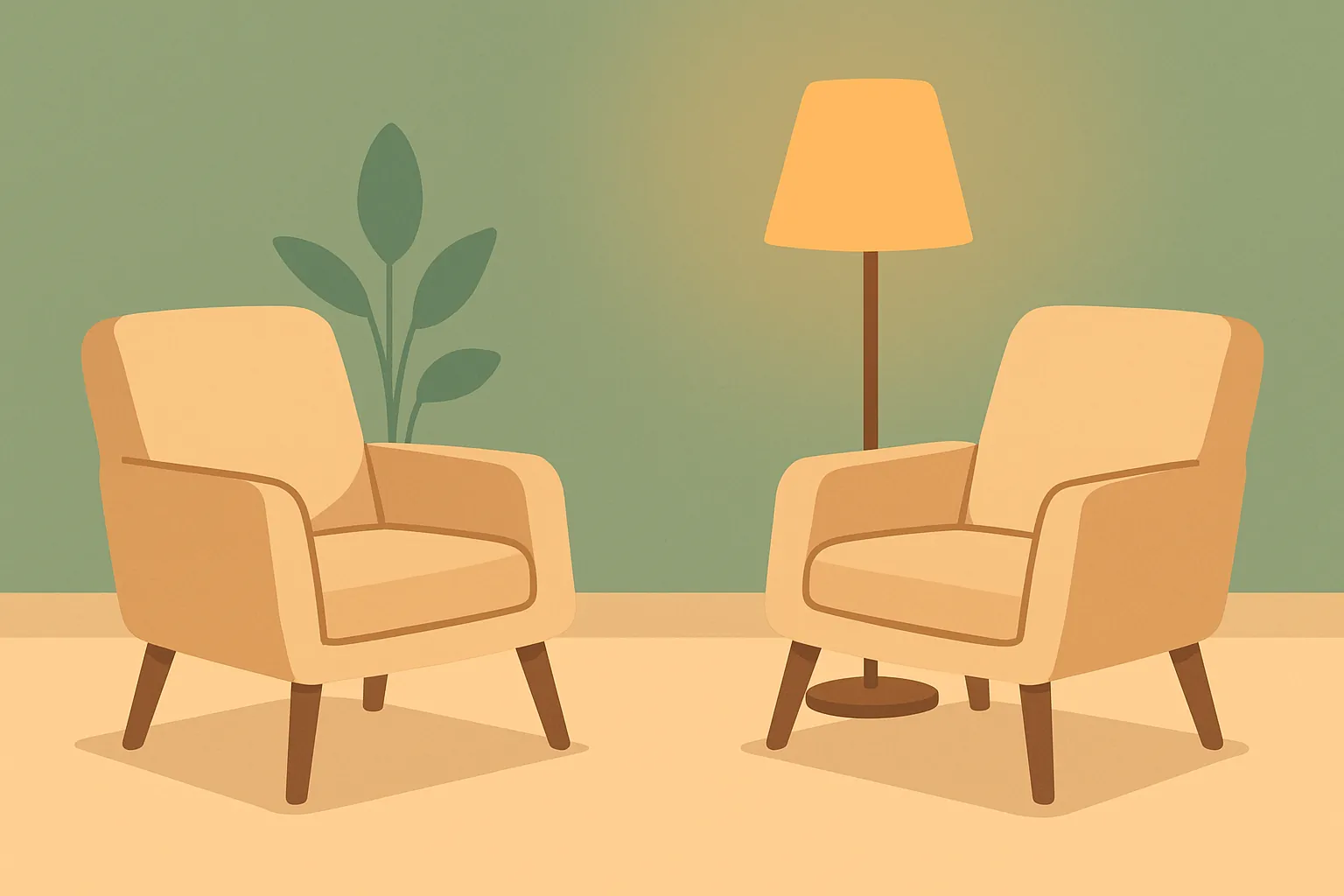
A strictly face-to-face arrangement can feel like an interrogation. For clients with social anxiety or interpersonal avoidance, direct, sustained eye contact is genuinely stressful. Angling the chairs roughly 90 to 120 degrees offers a natural escape route for the gaze: when a client needs to look away, they can, without it feeling like a rupture. That small degree of freedom lowers the pressure and makes harder conversations possible.
Physical Distance and the Comfort of the Furniture
A distance of about 1.2–1.5 meters (the near edge of social distance) tends to work best. Too close can feel intrusive; too far can feel like abandonment. The client's chair ideally cradles the body—something like a wingback—and sits at roughly the same eye level as the clinician's. If the clinician's chair is noticeably higher or larger, it can invite an authority-laden transference that undercuts the sense of a horizontal, collaborative relationship.
Balancing Openness and Security
The relationship between the door and the seating matters more than it seems. Clients unconsciously want to know where the exit is. Arrange seating so the client can either see the door or, at minimum, isn't seated with their back to it in a way that breeds unease. At the same time, positioning the clinician with a wall behind them helps the client experience the therapist as a steady, grounded anchor.
3. Completing the Space: Technology in Service of Full Presence
You can have perfect lighting and the most comfortable chairs in the world, but if your eyes are locked on a laptop screen or a notepad instead of the client, the room loses its therapeutic function. The finishing touch on a comfortable space is the clinician's full presence. Optimizing the physical environment matters—but so does optimizing the administrative and documentation workflow, so you can stay in genuine, here-and-now contact with the person in front of you.
Lighten the Documentation Load and Make Eye Contact
Many clinicians take near-verbatim notes for fear of missing something, and in doing so miss the subtle shifts in a client's expression. Modern, security-first AI tools—like Modalia AI, built for transcription, case conceptualization, and progress notes—can lift the compulsion to capture every word, freeing you to be fully with the client. The benefit goes beyond any physical upgrade: it gives the clinician psychological room to breathe.
Keep the Technology Out of the Way
When using any AI documentation tool, position the device so it never becomes a physical barrier between you and the client. Keep microphones or recording equipment discreet and out of the visual field. Sit with empty hands, relaxed, and meet the client's eyes. The felt sense that "my therapist is fully seeing me" is a more powerful agent of healing than any element of décor.
Start Small
You don't need to replace your furniture today. Begin with a few small shifts: (1) turn off the overhead fluorescents and switch on a lamp, (2) angle the chairs slightly off-center, (3) streamline your note-taking so you have more time for eye contact. These small, deliberate gestures accumulate until the client comes to remember your office as the safest refuge they know. Sometimes the key that opens a client's heart isn't a warm word—it's a warm light.
References
- 1.
- 2.
Frequently asked questions
What color temperature is best for a therapy room?
Warm white light in the 2700K–3000K range works best. It mimics late-afternoon sunlight, engages the parasympathetic nervous system, and helps clients lower their guard. Cool daylight or fluorescent lighting (6000K+) tends to raise arousal and tension. Favor indirect lighting—lamps and sconces—over harsh overhead fixtures.
How should chairs be arranged in a counseling office?
Angle the chairs roughly 90 to 120 degrees rather than directly face-to-face. This gives clients a natural escape route for their gaze, which is especially helpful for those with social anxiety. Keep about 1.2–1.5 meters between you and the client, and match eye levels to avoid an authority-laden dynamic.
Why does the physical environment matter for the therapeutic alliance?
A client's nervous system assesses the safety of a space within a fraction of a second of entering. The room functions as a concrete form of Winnicott's holding environment—felt safety in the space supports a client's willingness to be vulnerable, directly influencing rapport and the working alliance.
How can technology support presence instead of distracting from it?
Security-first AI documentation tools can reduce the compulsion to take near-verbatim notes, freeing clinicians to maintain eye contact and full presence. Keep any device or microphone discreet and out of the visual field so it never becomes a barrier between you and the client.
This article was written and reviewed using Modalia AI's clinical guidelines, with professional human review before publication.
Related articles
 Clinical Skills
How to Write Better Supervision Questions: Getting What You Actually Need from Your Supervisor
Stuck on what to ask in supervision? Use these structured question strategies to turn vague check-ins into focused clinical insight.
7 min read Clinical Skills
From "The Client Seems Depressed" to a Clinical Hypothesis: How Word Choice Elevates Your Case Reports
Turn vague observations into precise clinical hypotheses. A practical guide to terminology and sentence formulas that make your case reports read like expert work.
7 min read Clinical Skills
The Wounded Healer Trap: Why "I Want to Heal Myself" Sinks Your Counseling Grad School SOP
Why admissions faculty flinch at "I want to heal my own wounds"—and how to transform personal pain into a research-grade statement of purpose that gets you in.
6 min read