The Therapy Room as Co-Therapist: Clock Placement, Tissue Boxes, and the Setting Details Clinicians Miss
Where you place the clock and tissues shapes client disclosure and rapport. A clinical guide to setting up the physical space of your therapy room.
Key takeaway
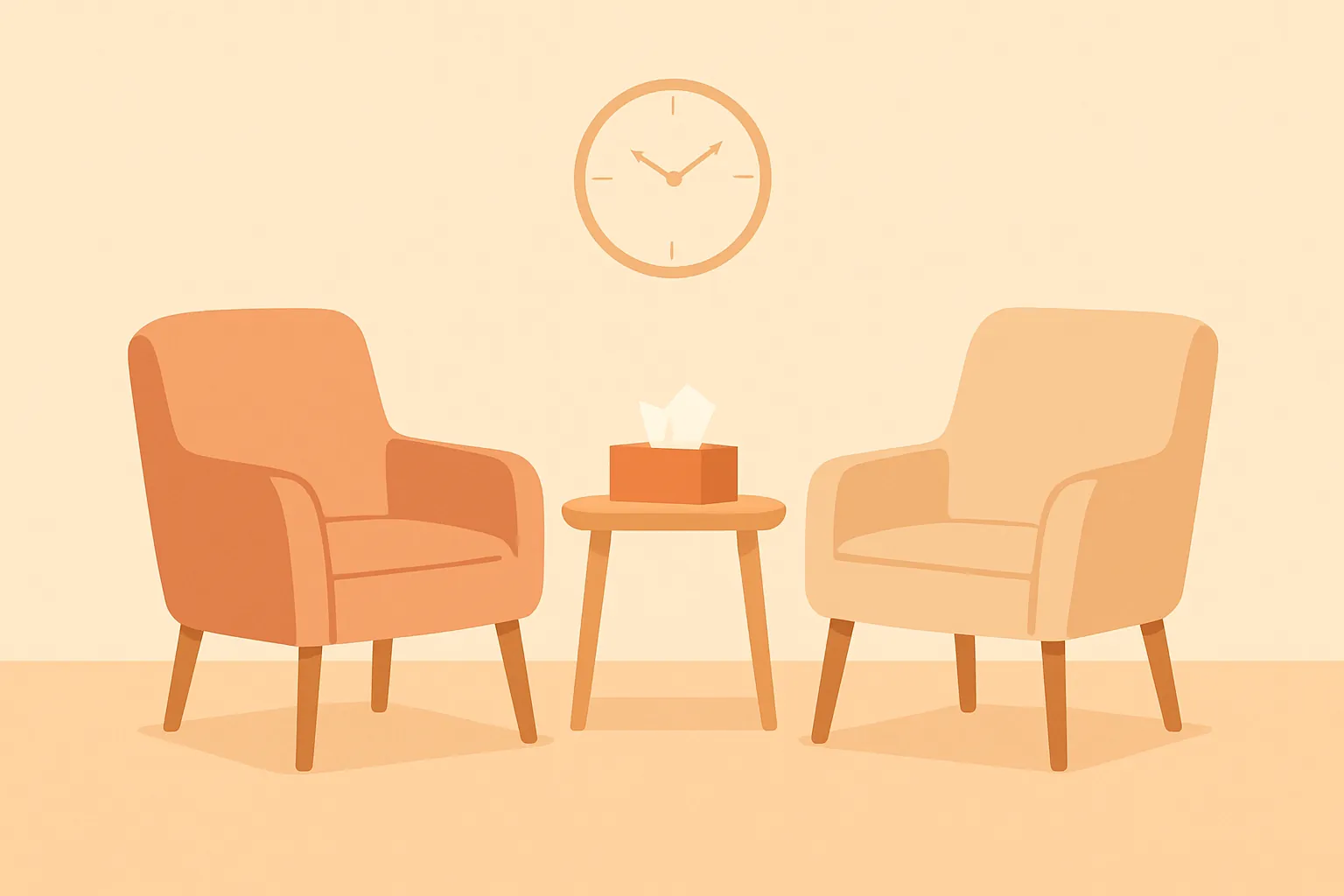
The physical environment of a therapy room directly influences how much a client discloses and how quickly a working alliance forms. As the tangible expression of Winnicott's holding environment, a well-ordered space lowers client anxiety and reduces the clinician's cognitive load. Place a silent clock behind the client and roughly 15–20° above your own line of sight so you can track time without breaking eye contact; keep a weighted, always-full tissue box on a side table within the client's own reach to respect their autonomy. Seats angled at 90–120° and set about 1.2–1.5 m apart support emotional connection without pressure, and keyword-only notes taken on a lap clipboard let you keep your gaze on the client and catch nonverbal cues.
When the Room Speaks Before You Do
You know the moment. A client finally breaks open, sobbing through something they've never said aloud — and the tissue box is on a desk across the room, out of reach. Or you're five minutes from the end of a session and need to check the time, but the only clock is behind you, so you steal an awkward glance at your wrist and feel the client's focus shatter.
We pour enormous energy into the content of therapy: the transcript, the theory, the intervention. We pour much less into the container that holds it — the physical environment of the room itself. Yet in early sessions, and any time you're still building a working alliance, the nonverbal layer of the room is doing clinical work. It is quietly telling the client, "You are safe here."
The purpose of this article is to walk through the setting details that novice clinicians most often overlook — the ones that can quietly shape whether therapy succeeds.
The Room as Therapeutic Frame
From a clinical standpoint, the consulting room is the physical expression of what Winnicott called the holding environment. An ordered, predictable space lowers client anxiety, signals professional competence, and helps maintain therapeutic boundaries. It is not décor; it is part of the frame.
How physical space shapes rapport
Clients form a fast, largely unconscious read on safety the moment they walk in. Environmental factors — lighting, seating arrangement, sound insulation — are tied directly to self-disclosure. A cluttered room, or a seating setup where the clinician appears to stare the client down head-on, invites defensive postures the client may not even be aware of adopting.
Space and clinician burnout
The environment matters for the clinician too. For someone running four to six cases a day, a room with awkward flow — where finding a pen or a fresh tissue box demands a small hunt — adds to cognitive load. Background thoughts like "Where's the clock?" or "Are we out of tissues?" pull you out of the here-and-now and erode your presence with the person in front of you.
The Clock and the Tissue Box: Boundary and Permission
The smallest details produce some of the most consequential mistakes — and two of the worst offenders are the clock and the tissues. One represents a reality boundary (time); the other represents emotional permission (tears). Place them poorly and you interrupt the therapeutic flow or send the wrong signal.
| Element | Common novice mistake | Clinical best practice | Why it matters |
|---|---|---|---|
| Clock placement | Behind the clinician, facing the client, or worse, a wristwatch | Behind the client, ~15–20° above your own line of sight | Lets you check the time while holding eye contact, preserving presence |
| Clock type | A ticking analog clock | A silent analog clock | Removes an auditory anxiety cue during silences; reduces felt time pressure |
| Tissue placement | Far enough that you must pull a tissue and hand it over | On a side table within the client's own reach | Respects autonomy; handing a tissue can read as "that's enough crying now" |
| Tissue supply | A near-empty box so light it lifts off the table | Always full, in a weighted holder | Communicates a wordless steadiness — the room can hold whatever they bring |
Notice the through-line: each choice either protects the client's autonomy or protects your presence. Handing someone a tissue feels caring, but in a charged moment it can be received as a cue to compose themselves. Letting them reach for it themselves keeps the permission to feel firmly in their hands.
Seating and Distance: Proxemics in Practice
Face-to-face, or gently angled?
Sitting directly across a desk reads as authoritative and evaluative — fine for interpreting a psychological assessment, but worth avoiding elsewhere. The more workable arrangement places the chairs at an angle of 90° to 120°. That geometry gives the client somewhere natural to rest their gaze when sustained eye contact feels like too much, easing the sense of being scrutinized.
The distance between two chairs
Drawing on Edward T. Hall's work on proxemics, the boundary between social and personal distance — roughly 1.2 to 1.5 meters — tends to suit therapy best. Too far apart and emotional connection is hard to reach (the client feels held at arm's length); too close and the client may feel encroached upon. When you set up the room, sit in the client's chair and look toward yours. Check the distance, the angle, and the sightline from where they will actually be sitting.
The Invisible Setup: Note-Taking and Technology
Just as important as the furniture is the setup for documentation. If you spend the session head-down, transcribing what the client says, or if a laptop screen sits like a wall between you, that becomes a psychological barrier larger than any physical one.
The note-taking dilemma
Many early-career clinicians take near-verbatim notes so as not to lose anything — and in doing so lose the very thing they can't recover later: the shift in a client's expression, the tremor in their hands, the nonverbal cues that never make it onto the page. A more sustainable habit is to keep notes on a lap clipboard rather than a desk, hold your gaze on the client, and write in keywords only.
The smart consulting room
Increasingly, clinicians are using AI tools so that their cognitive energy goes to the relationship rather than the record. If you reach for technology, place any recording device unobtrusively — at the edge of a desk, beside a plant — while still naming it clearly and obtaining informed consent up front. The device should never be hidden, only kept from feeling like a spotlight.
The Space Is Your Second Therapist
The position of a clock, the weight of a tissue box — to the client, these add up to a single message: I am ready to hold what you bring. So audit your own room today. Sit in the client's chair and look back at yours. Can you see the clock from there? Are the tissues easy to reach? And are you losing eye contact to your own note-taking?
If the pressure of documentation keeps pulling your gaze down and breaking the flow, a modern AI transcription tool can be a genuine help. While it accurately converts the conversation to text and separates speakers, you stay fully present to the client's eyes and the catch in their voice.
A three-step check for today:
- Sit in the client's chair, look toward yours, and confirm your sightline to the clock.
- Lift the tissue box — if it feels weightless, refill it so it has some heft.
- Try an AI transcription tool that can take the documentation load off your shoulders.
Modalia AI is built for exactly this: a security-first AI partner that handles session transcription, case conceptualization support, and documentation so clinicians can stay where the work really happens — in the room, with the client.
References
- 1.
- 2.
Frequently asked questions
Where should a clock go in a therapy room?
Place a silent analog clock behind the client and roughly 15–20° above your own line of sight. This lets you track time naturally while maintaining eye contact, so checking the clock never reads as impatience or breaks the client's focus.
Should I hand a client a tissue when they cry?
Generally no. Keep a full, weighted tissue box on a side table within the client's own reach. Handing a tissue in an emotional moment can be misread as a signal to stop crying, whereas letting the client take one themselves respects their autonomy and permission to feel.
What is the ideal seating distance and angle for counseling?
Arrange chairs at a 90–120° angle and about 1.2–1.5 meters apart. The angle gives the client a natural place to rest their gaze, and the distance — the edge of personal and social space in Hall's proxemics — supports emotional connection without feeling intrusive.
How can I take session notes without losing eye contact?
Use a lap clipboard instead of a desk, keep your gaze on the client, and write in keywords only. For fuller records, an AI transcription tool can capture and speaker-separate the conversation so you stay present for nonverbal cues during the session.
This article was written and reviewed using Modalia AI's clinical guidelines, with professional human review before publication.
Related articles
 Clinical Skills
How to Write Better Supervision Questions: Getting What You Actually Need from Your Supervisor
Stuck on what to ask in supervision? Use these structured question strategies to turn vague check-ins into focused clinical insight.
7 min read Clinical Skills
From "The Client Seems Depressed" to a Clinical Hypothesis: How Word Choice Elevates Your Case Reports
Turn vague observations into precise clinical hypotheses. A practical guide to terminology and sentence formulas that make your case reports read like expert work.
7 min read Clinical Skills
The Wounded Healer Trap: Why "I Want to Heal Myself" Sinks Your Counseling Grad School SOP
Why admissions faculty flinch at "I want to heal my own wounds"—and how to transform personal pain into a research-grade statement of purpose that gets you in.
6 min read