Transactional Analysis (TA) in Practice: Reading Communication Through the Parent-Adult-Child Model
Use Eric Berne's Parent-Adult-Child model to diagnose crossed and ulterior transactions, strengthen the client's Adult, and move stalled sessions forward.
Key takeaway
Transactional Analysis (TA), developed by Eric Berne, uses the Parent-Adult-Child (P-A-C) model to map the communication patterns that play out in the consulting room. Effective intervention starts with diagnosing which ego state is actually speaking — reading not just content but tone and context — and resisting the novice error of accepting a contaminated ego state at face value. When therapy stalls, look for crossed or ulterior transactions, lead with empathy from the Nurturing Parent before inviting the client's Adult, and reorganize the stroke economy so healthy communication is what gets reinforced.
"Why do our conversations always miss each other?" — How the P-A-C Model Unblocks Stuck Therapy
Most clinicians have heard some version of these complaints: "Every time I try to talk to my husband, it's like talking to a wall," or "My manager treats me like a child and I can't stand it." And if we're honest, we feel it ourselves — moments in session where we slip into lecturing a particular client like a parent, or shrink and start reading their mood like a wary child. These are familiar countertransference pulls. So where do these invisible patterns of communication actually come from?
Eric Berne's Transactional Analysis (TA) untangles the knots of human relating with a remarkably intuitive instrument: the ego state. For the working clinician, TA is more than a way to categorize personality. It is a clinical tool for catching — and correcting — the moment communication goes off the rails here and now. Helping a client stop the unconscious "games" they replay, and recover genuine autonomy, sits squarely at the center of what therapy is for.
But knowing the theory and applying it to a live exchange are two different skills. How do I move a guarded, resistant client toward their Adult? How do I efficiently spot the markers of a crossed transaction in my session notes? These are the practical questions. This article works through the P-A-C model as a way of analyzing communication, and offers concrete strategies for putting it to work in the room.
1. A Clinical Anatomy of P-A-C: Where Is the Client's Voice Coming From?
Every sentence a client speaks, every gesture, carries the fingerprint of a dominant ego state. Before any useful intervention, the clinician has to diagnose which state is active. Saying a client "is just sensitive" gets you nowhere; deciding whether that sensitivity issues from a Critical Parent (CP) or an Adapted Child (AC) changes the entire therapeutic approach.
The table below breaks the functional ego states into clinically useful units — the verbal and nonverbal cues that let you read the state quickly, and a corresponding response.
| Ego State | Core Features & Keywords | Clinical Cues (verbal / nonverbal) | Clinician's Response Strategy |
|---|---|---|---|
| Parent (P) – Critical Parent (CP) – Nurturing Parent (NP) | Values, morality, rules, protection "You should…", "You can't." | Commanding tone, furrowed brow, crossed arms; or excessive worry and intrusion | Respect the client's values, but explore the irrational injunctions beneath them and invite a redecision |
| Adult (A) – Objective data processor | Facts, logic, reality-testing "What's actually true here? How do we solve it?" | Calm tone, steady eye contact, open posture; fact-focused, affect-neutral narration | Strengthen the Adult so it can mediate between feeling (C) and rules (P) — decontamination |
| Child (C) – Free Child (FC) – Adapted Child (AC) | Emotion, need, creativity, intuition "I want…", "I'm scared." | Higher pitch, laughter, tears, hunched shoulders; placating or impulsive stance | Support the FC's creativity; help discharge the AC's suppressed affect and explore the early decision |
Table 1. Identifying and responding to P-A-C ego states in clinical practice.
A common novice error is to accept a client's contaminated ego state at face value. A statement may sound like clear Adult fact, when in reality the Adult has been contaminated by prejudice (Parent) or by a delusional fear (Child) — reality distorted and then reported as truth. So the clinician must analyze not only what is said but its tone and context, and keep asking the central question: who is speaking right now?
2. Breaking the Loop of Crossed and Ulterior Transactions
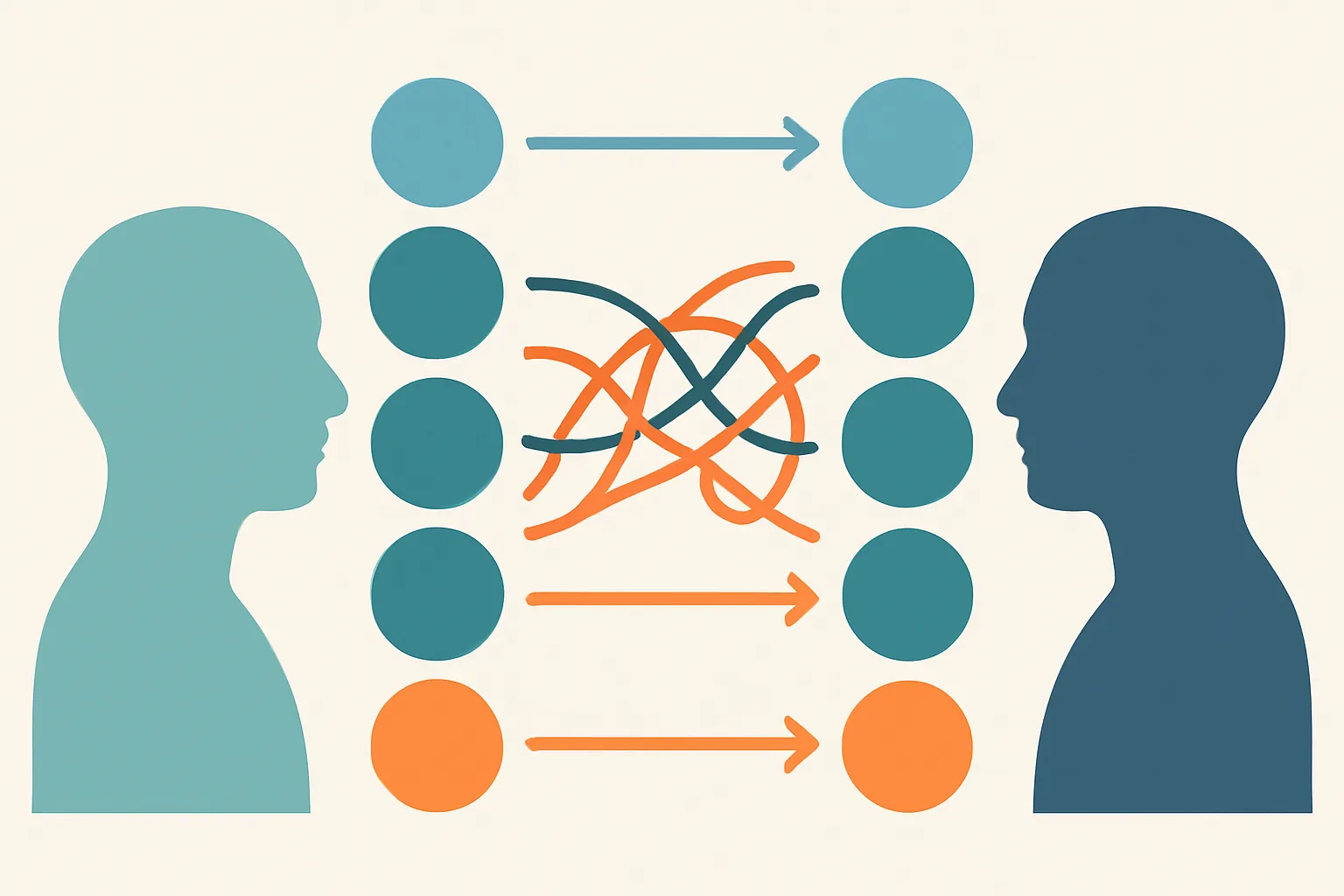
When therapy stalls or a client digs into resistance, the cause is usually found in a crossed transaction or an ulterior transaction. You ask a calm, logical question (A→A) and the client flares up defensively (C→P, or P→C): the vectors of the exchange have crossed. More insidious is the ulterior transaction — on the surface the client agrees (A–A) while underneath they are quietly mocking you or angling to make you take over (C–P). Here are four practical ways to work with this.
-
When a transaction crosses, retreat to a complementary one — for now
When a client is emotionally flooded and showing the Child (C), forcing Adult logic onto them only stiffens the resistance. The strategic move is for the clinician to deliberately use the Nurturing Parent (NP) to meet and hold the feeling — a complementary P–C transaction. "That must have felt so unfair" has to come first. Only once the client's state settles can you extend an invitation back to the Adult.
-
Strengthening the Adult to remove contamination
The ultimate aim is for the client's Adult to regulate and arbitrate between Parent and Child. You can activate the Adult with questions such as:
- "How closely does the feeling you just had match what's actually happening right now?" (reality-testing)
- "That thing your mother told you as a child — is it still true for the person you are today?" (prompting critical reflection)
Questions like these interrupt an automatic reaction — they make the client stop and think.
-
Monitoring your own ego state, and using supervision
Clinicians are human and can get hooked by a particular client reaction, so that an unwanted ego state surfaces. With clients who have borderline or narcissistic features especially, projective identification frequently maneuvers the clinician into playing the punitive Parent (CP) or the helpless Child (AC). To examine your own patterns objectively, work from an accurate session transcript and discuss with a supervisor which of your ego states got activated and why.
-
Reorganizing the stroke economy
Many clients repeat problem behavior because even negative attention (a negative stroke) is attention. When a client shows authentic relating or healthy Adult activity, the clinician should offer an immediate, positive stroke — teaching experientially that healthy communication is what gets rewarded. This resembles behavioral reinforcement, but differs in being grounded in genuine emotional exchange.
3. Sharpening Clinical Precision With the Right Tools
TA is at its most powerful when you analyze an interaction at the micro level. But tracking every P-A-C dynamic in real time during a session is close to impossible — your cognitive resources are finite, and your attention belongs on the client's nonverbal cues. This is where concrete practices, and a thoughtful use of technology, earn their place.
A few action items for TA-informed work:
- Measure ego state energy periodically: Administer an Egogram at the start, midpoint, and end of treatment to visualize how ego state energy shifts over time, and review it together with the client. (Confirm which assessment instruments are validated and available in your own region.)
- Train your ear for key phrases: Practice flagging the words clients lean on — "always" and "never" (Parent language), or "I don't know" and "I had no choice" (Adapted Child language).
- Analyze patterns from accurate records: Reconstructing the exact wording at the moment a transaction crossed matters. Memory-based notes are vulnerable to the clinician's own defenses and tend to distort what happened.
This is where an AI-assisted session-documentation and transcription workflow becomes a genuinely useful ally. To analyze a client's P-A-C patterns, you need a record that is faithful down to the word. Good tools do more than convert speech to text — they preserve turn-taking and the nuance of an utterance, so you can review the exchange as it actually unfolded.
An accurate transcript lets you observe your own crossed transaction objectively — "Ah, so that's how I responded in that moment" — and frees you from the drudgery of typing so your attention can go to finding the hidden ulterior transaction and exercising Adult clinical judgment. Used with appropriate consent and data safeguards, this is both a way of meeting your ethical obligations and a smart way to raise your level as a practitioner. Modalia AI is built for exactly this kind of work: a security-first AI partner for counselors, supporting transcription, case conceptualization, and documentation so the clinical thinking stays with you.
Transactional Analysis rests on a hopeful premise: people can change. The work of analyzing a client's tangled ego states clearly, and intervening well enough to help them recover their autonomy, is a long road — and a deep grasp of the P-A-C model, paired with modern analytic tools, makes a dependable compass for it.
References
- 1.
- 2.
Frequently asked questions
What are the three ego states in Transactional Analysis?
Eric Berne's model identifies Parent (P), Adult (A), and Child (C). The Parent holds values, rules, and protection (split into Critical and Nurturing); the Adult processes facts and tests reality; the Child carries emotion, need, and creativity (split into Free Child and Adapted Child). Each can be read from a client's tone, language, and posture.
What is the difference between a crossed and an ulterior transaction?
A crossed transaction occurs when the response comes from a different ego state than the one addressed — you ask Adult-to-Adult and the client answers defensively from Child or Parent, so the exchange misfires. An ulterior transaction carries a hidden psychological message beneath the social one: the client appears to agree (Adult-to-Adult) while a covert Child-to-Parent agenda is really driving the interaction.
How can a clinician move a resistant client toward their Adult ego state?
Lead with empathy from the Nurturing Parent to settle an emotionally flooded Child first — forcing Adult logic too early hardens resistance. Once the client is regulated, use reality-testing and reflective questions ("How well does that feeling fit what's actually happening now?") to interrupt the automatic reaction and activate Adult thinking.
What is contamination in Transactional Analysis?
Contamination is when Parent prejudice or Child fear intrudes on the Adult and gets reported as objective fact. A statement can sound like clear, rational Adult while actually being driven by bias or distorted fear. Because of this, the clinician analyzes tone and context — not just content — to decide which ego state is genuinely speaking.
This article was written and reviewed using Modalia AI's clinical guidelines, with professional human review before publication.
Related articles
 Case Conceptualization
Breaking the "Yes, But" Game: A Transactional Analysis Guide for Therapists
Every suggestion you offer gets met with "Yes, but..." Here's the TA structure behind that stall—and four clinical moves to break it.
7 min read Case Conceptualization
Yalom's The Gift of Therapy: Passages Every New Counselor Should Copy by Hand
Irvin Yalom's prescription for therapists who fear silence: meet your client as a "fellow traveler" and let the here-and-now become the heart of the work.
6 min read Case Conceptualization
Working With Silence in Therapy: What Client Silence Means and How to Hold It
Silence in session isn't empty space. Learn to read its clinical meaning, tell productive from defensive silence, and use it as a therapeutic tool.
6 min read