Vocal Health for Therapists: How to Protect Your Voice Across 5+ Sessions a Day
A survival guide for therapists running 5+ sessions a day: why your voice tires, and practical ways to protect the most irreplaceable tool in your clinical toolkit.
Key takeaway
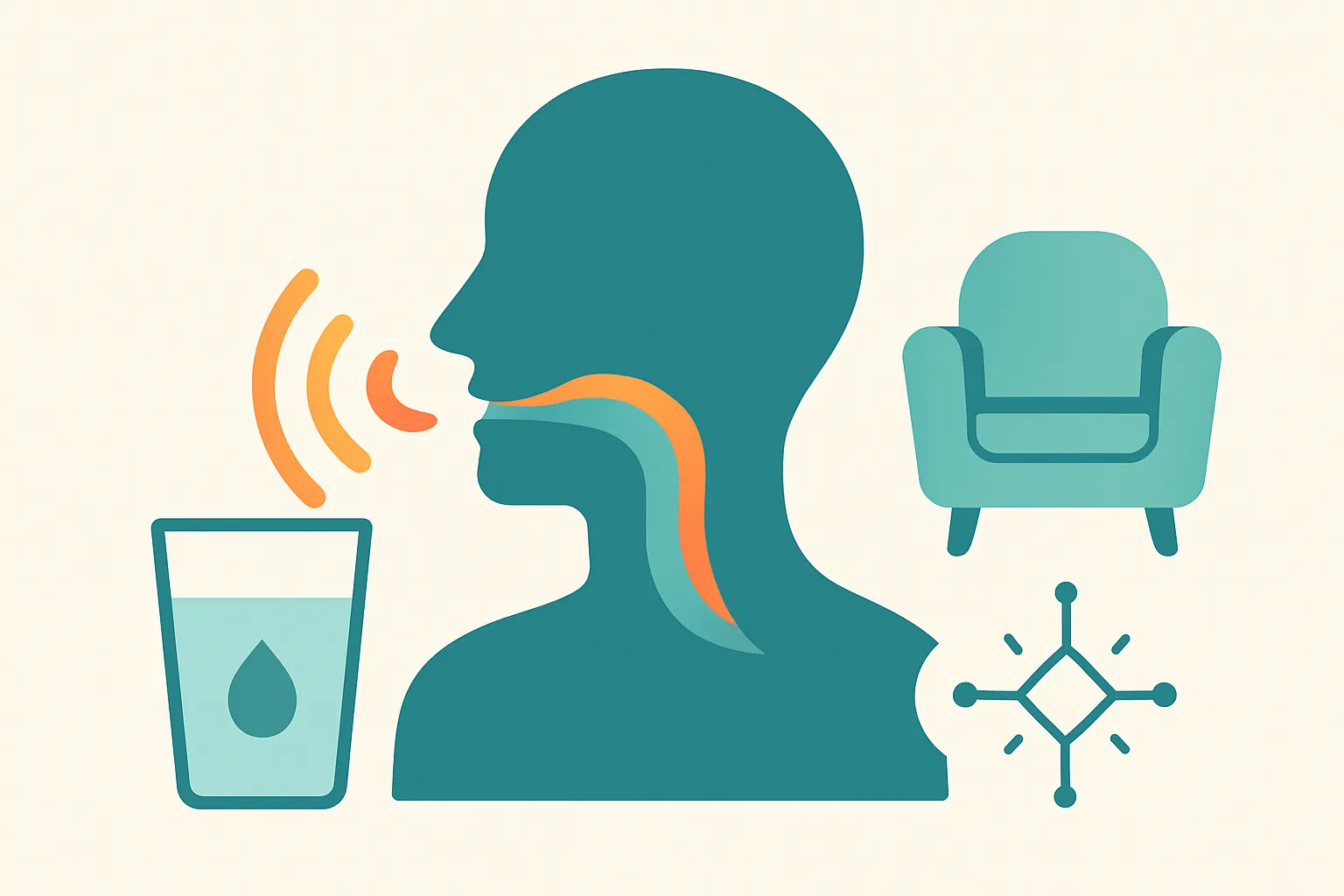
For a therapist seeing five or more clients a day, the voice is not just a means of conversation—it is a core clinical instrument for building the therapeutic alliance. Emotional mirroring and cognitive overload tighten the laryngeal muscles and shorten the breath, leading to vocal fatigue and physical burnout. To protect vocal health, sip lukewarm water every 10–15 minutes, keep the office humidity at 50–60%, and use therapeutic silence deliberately. Because chest breathing, forward-head posture, and an artificially lowered tone all strain the vocal folds, clinicians do better with diaphragmatic breathing, a neutral posture, and speaking in their own comfortable pitch range.
When Your Voice Gives Out, Does Your Empathy Stop Too?
If you see five clients a day—sometimes seven or eight—you know the feeling of the drive home with a voice that has gone hoarse, or that barely comes out at all. We like to call therapy "the art of conversation," but from a physiological standpoint, a full caseload is also a form of high-intensity vocal labor.
A therapist's voice is far more than a delivery system for information. It conveys safety, carries affect, and is one of the most powerful clinical instruments we have for building the therapeutic alliance. Yet many clinicians are so attentive to their clients' inner worlds that they ignore the warning signals coming from their own most essential tool: the voice. Throat fatigue feeds physical burnout, and burnout erodes both the quality of the work and our capacity for empathy. This piece is about protecting your professional voice—and managing your energy more efficiently—across a relentless schedule.
Why a Therapist's Voice Wears Out Faster
Clinical speech places a heavier load on the vocal folds than ordinary conversation does, and it isn't simply because we talk a lot. The culprits are emotional mirroring and tension-driven phonation. When we attune to a client's painful affect, the muscles around the larynx quietly contract and the breath grows shallow. When a client cries or becomes agitated, we unconsciously modulate and restrain our own tone—and in doing so, vocal-fold contact often rises to an unhealthy level, accumulating fatigue session after session.
The cognitive overload of a packed day adds another layer of physical tension. While we are formulating the next response, tracking countertransference, and scanning for anything we might have missed, the muscles of the neck and shoulders stiffen. That tension interferes with resonance and pushes us toward a pressed voice—the squeezed, effortful sound of a throat working too hard. The takeaway: vocal care is not about "talking less." It's about releasing the psychological tension of the session at the level of the body.
A Vocal-Recovery Routine You Can Use Between Sessions
You don't need formal vocal training. Small changes to your habits and your office environment go a long way. Use even a ten-minute break to let your voice recover.
- Hydrate in sips, not gulps. Reaching for water mid-session and drinking it all at once doesn't deliver lasting moisture to the vocal-fold mucosa. Across a 50-minute session, sipping lukewarm water every 10–15 minutes—just enough to wet the mouth and throat—keeps the tissue lubricated far more effectively.
- Hold the room at 50–60% humidity. Soundproofed offices are notoriously hard to ventilate and tend to run dry. A small desktop humidifier keeps the air between you and your client comfortable—and the moist, settled atmosphere offers a quiet nonverbal cue of ease.
- Use silence therapeutically. Let go of the compulsion to fill every pause. Therapeutic silence serves the client's insight and rests your voice. When you can sit comfortably in a silence, clients often move into deeper, more honest territory.
Harmful Vocal Habits vs. Healthy Clinical Phonation
Many clinicians injure their voices trying to manufacture the calm, low "therapist tone." Artificially dropping your pitch presses the larynx down and strains the folds. Use the table below to check your own habits.
| Element | Habits that harm the voice ❌ | Habits that protect the voice ✅ |
|---|---|---|
| Breathing | Chest breathing, with the shoulders rising | Diaphragmatic breathing that expands the belly and lower ribs |
| Posture | Forward-head posture, craning toward the client (laryngeal compression) | Neutral posture with ears aligned over shoulders (laryngeal ease) |
| Tone | An artificially lowered pitch, or a breathy half-whisper | Your own comfortable pitch range, using nasal resonance |
| Reactions | Frequent, effortful verbal fillers ("mm-hm, mm-hm," "I see, I see") | More nonverbal communication—eye contact, nodding |
Easing the Documentation Burden to Protect Your Voice and Energy
Across a heavy caseload, the thing that drains you as much as your voice is the weight of documentation. The pressure to remember and record everything raises your tension during the session itself—and that tension travels straight to the throat. Writing charts or cleaning up session transcripts the moment a client leaves, with no breather in between, eats the physical rest you need.
This is where technology can help you stay fully present. When you can let go of frantic note-taking and the effort to memorize, your breathing settles and so does your voice. AI-assisted transcription tools—services like Whisper or Otter.ai—can turn a recorded session into searchable text so you're not carrying the whole hour in your head. (Always obtain informed consent and use a tool that meets your jurisdiction's privacy and security standards before recording any client.) Remember: your energy has to be preserved before it can flow, intact, toward the client.
A Sustainable Practice Starts With Your Voice
Your voice is an irreplaceable instrument of healing. Keeping it healthy through a demanding schedule isn't just self-care—it's part of the professional ethic of giving clients your best work. Try today's three essentials—steady hydration, healthy phonation and posture, and the deliberate use of silence—starting with your very next session.
Minimizing the energy you spend outside the conversation is part of protecting your voice, too. A relaxed body and an unstrained voice may be exactly what your clients need most from you.
Frequently asked questions
Why does a therapist's voice tire faster than in ordinary conversation?
Clinical speech adds emotional mirroring and tension-driven phonation on top of sheer talk time. Attuning to a client's distress tightens the laryngeal muscles and shortens the breath, raising vocal-fold contact and accumulating fatigue. Cognitive load—tracking countertransference and planning responses—stiffens the neck and shoulders and pushes the voice into a strained, pressed quality.
What's the best way to hydrate during back-to-back sessions?
Sip lukewarm water every 10–15 minutes rather than gulping it all at once when you feel thirsty. Small, frequent sips keep the vocal-fold mucosa consistently lubricated, while a single large drink doesn't deliver lasting moisture. Keeping the office at 50–60% humidity supports this further.
Is the calm, low "therapist tone" bad for my voice?
Artificially lowering your pitch presses the larynx down and strains the vocal folds over a full day. It's healthier to speak in your own comfortable pitch range, using nasal resonance, with diaphragmatic breathing and a neutral, ears-over-shoulders posture instead of a forward-head lean.
How does documentation affect vocal strain?
The pressure to remember and record everything raises in-session tension, which travels to the throat, and writing notes immediately afterward erases the rest your voice needs. Reducing that load—e.g., with consented, privacy-compliant AI transcription—lets your breathing settle and frees you to focus on the conversation.
This article was written and reviewed using Modalia AI's clinical guidelines, with professional human review before publication.
Related articles
 Case Conceptualization
Breaking the "Yes, But" Game: A Transactional Analysis Guide for Therapists
Every suggestion you offer gets met with "Yes, but..." Here's the TA structure behind that stall—and four clinical moves to break it.
7 min read Case Conceptualization
Yalom's The Gift of Therapy: Passages Every New Counselor Should Copy by Hand
Irvin Yalom's prescription for therapists who fear silence: meet your client as a "fellow traveler" and let the here-and-now become the heart of the work.
6 min read Case Conceptualization
Working With Silence in Therapy: What Client Silence Means and How to Hold It
Silence in session isn't empty space. Learn to read its clinical meaning, tell productive from defensive silence, and use it as a therapeutic tool.
6 min read