Voice Care for Therapists: How to Protect Your Vocal Cords Across a 6-Session Day
Six back-to-back sessions don't have to leave you hoarse. Learn resonance-based voice techniques, a session-by-session hydration routine, and how to cut your total vocal load.
Key takeaway
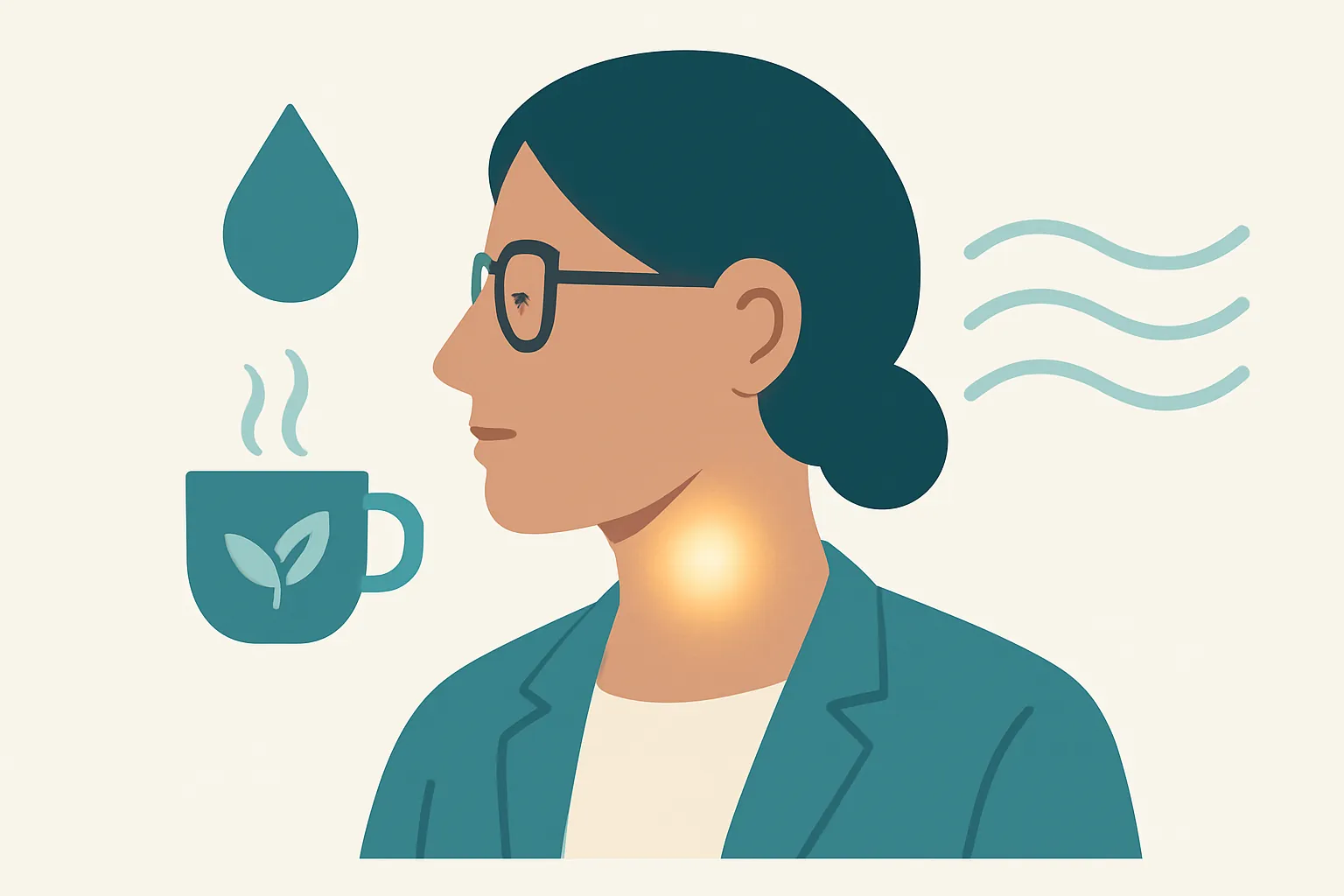
For a therapist, the voice is one of the most powerful clinical tools you have—it carries empathy, regulates tone, and helps build the working alliance. Clinicians who run six or more sessions a day are doing sustained 'clinical vocal labor': holding a controlled, low, steady tone for hours, which puts them at real risk for vocal fatigue and nodules. You can protect your voice by using mask-resonance techniques like lip trills and humming, following a three-stage hydration routine before, during, and after sessions, and reducing your out-of-session voice use—including by letting AI transcription tools draft your session notes instead of re-listening and dictating.
When Your Voice Gives Out, So Does Your Empathy
How many sessions did you run today? When you spend 50 minutes fully attuned to a client, take a 10-minute breather, and then do it all again—six or more times—it's no surprise that by early evening your voice feels rough or your throat feels tight. For a clinician, the voice is far more than a way to exchange information. It's one of your most powerful clinical tools: the instrument through which you convey empathy and build the therapeutic alliance.
Yet many of us listen carefully to a client's distress while ignoring the distress signals from our own vocal cords. When your throat is strained, it becomes harder to modulate the nonverbal layer of communication—tone and intonation—and that subtly erodes your attuned, empathic responses and, ultimately, the quality of the work. Chronic vocal nodules can also shorten a clinician's career. This article breaks down why therapists experience vocal fatigue and offers practical, immediately usable voice techniques and a hydration routine you can fold into your day.
1. The Hidden Vocal Load of "Therapeutic Speech"
Speaking in session is not like everyday conversation. To hold a client's emotional experience, we sustain a controlled tone, a steady, grounding lower register, and clear articulation—often for the full 50 minutes. Think of it as clinical vocal labor.
- Sustained low-level tension. To track and respond to a client, your laryngeal muscles rarely get to fully relax. Even minimal encouragers—a soft "mm-hmm"—require vocal-fold contact. Over an hour, that adds up.
- Bracing while empathizing. When you're meeting a client's grief or pain, it's easy to unconsciously tighten your throat or hold your breath. That breath-holding places excess pressure on the larynx and is a leading contributor to vocal nodules.
- A dry consulting room. Rooms built for privacy tend to be sealed and poorly ventilated, which leaves the air dry. Dry air dehydrates the vocal-fold mucosa and increases friction with every word.
Therapeutic Speech vs. Everyday Conversation: Vocal Load
| Factor | Everyday Conversation | Therapeutic Dialogue | Vocal Risk |
|---|---|---|---|
| Breathing | Irregular, shallow breaths are fine | Steady, deep (diaphragmatic) support required | High—shallow breathing recruits the throat |
| Pitch range | Free to move anywhere | Tends toward a steady, reassuring mid-low register | Moderate—an artificially lowered pitch strains the folds |
| Speech density | Frequent pauses | Verbal and nonverbal feedback even while listening | Highest—muscles work with little rest |
Table 1. Comparison of vocal-load factors in everyday vs. therapeutic speech.
2. Resonance-Based Voicing and Breath Technique to Prevent Nodules
Most therapists' throats hurt because they speak from the throat. To get through six or more sessions, you want to rely less on the vocal folds themselves and more on breath pressure and resonance in the head and oral cavities. It's the same principle a trained singer uses to project without a microphone—except in the consulting room your goal is a small but well-supported sound, not volume.
Using Mask Resonance
"Mask resonance" means speaking with a sensation of vibration in the front of the face—the area a mask would cover. Bringing the sound's focus forward to the lips lets you release unnecessary tension around the throat.
- Warm up (lip trills). Three minutes before your first session, let your lips flutter loosely on a "brrr" sound. This relaxes the muscles around the larynx and settles your breath.
- Find the placement with humming. With your mouth closed, hum an "mmm" and notice the tickling vibration around your nose and lips. Practice responding in session—"Mm, I see"—from that forward placement rather than from deep in the throat.
- Make diaphragmatic breathing a habit. As you listen, breathe deep into the belly without letting your shoulders rise. The air pressure you bank on the inhale acts as a cushion that protects the vocal folds.
3. A Strategic Hydration and Environment Routine
"Won't sipping water mid-session break the flow?" It's a common worry. But carrying on with a cracking voice is far more disruptive to a client's immersion than a brief pause. Strategic hydration not only protects vocal health—it can become a way to use therapeutic silence intentionally.
A Three-Stage Hydration Protocol
- Pre-session. Slowly drink a glass of room-temperature water to moisten the vocal-fold mucosa. Skip caffeinated coffee or tea right before a session—the diuretic effect can leave your folds drier.
- In-session. When a client falls into deep thought or gathers their emotions, that silence is also your moment of vocal rest. Take a small sip and let it ease down gradually. Done unhurriedly, it doubles as a nonverbal signal that you're giving the client room and time.
- Post-session. During your 10-minute break, reserve at least two minutes of genuine silence while you rehydrate. Rather than a strongly mentholated lozenge (which can be drying), a soothing herbal or throat-coat tea is gentler on the mucosa.
4. The Art of Silence: Lowering Your Total Vocal Output
If you're running six sessions a day, you need to ruthlessly limit voice use outside of session. Yet many clinicians keep talking long after the last client leaves—writing case notes aloud, preparing for supervision, drafting transcripts, or muttering along while re-listening to recordings. Cutting this administrative vocal labor is central to protecting your voice.
Workflow Habits That Give Your Voice a Rest
- Keyword-first notes. Don't try to capture everything in session. Jot core keywords and affect words so your post-session review is shorter.
- Let an AI transcription tool carry the load. A growing number of clinicians use speech-to-text (STT) services that automatically convert session recordings into text and separate speakers to produce a working draft of the transcript.
- Less vocal fatigue. You no longer need to replay recordings and dictate along with them—removing one of the biggest sources of off-session voice strain.
- Sharper clinical thinking. Instead of spending energy on stenography, you can review surfaced patterns—recurring themes or a client's central presenting concerns—and put your attention where it belongs: case conceptualization. Modalia AI, a security-first AI partner built for counselors, is one example of a tool designed to support transcription, documentation, and case conceptualization with client confidentiality in mind.
- Switch to "listening" mode with peers. In peer study groups and gatherings, favor a listening posture over active speaking. It's a small, wise way to bank vocal rest.
A therapist's voice is like a hand that soothes a client's mind. With the resonance practice, strategic hydration, and workflow changes outlined here, you can protect that precious instrument. When your voice stays healthy, you can stay with your clients—longer, and more deeply.
Frequently asked questions
Why do therapists develop vocal problems more than other professionals?
Therapeutic speech demands a sustained, controlled, low-register voice with clear articulation for the full session—what we might call 'clinical vocal labor.' Add unconscious throat-bracing while empathizing with distress and the dry, sealed air of a private consulting room, and the vocal folds rarely get a chance to recover across a full caseload.
What is mask resonance and how does it protect the voice?
Mask resonance means voicing with a sensation of vibration in the front of the face (where a mask sits) rather than pushing from the throat. By focusing the sound forward to the lips—practiced with lip trills and humming—you release tension around the larynx and rely on breath support instead of straining the vocal folds.
Is it unprofessional to sip water during a session?
No. Carrying on with a cracking, hoarse voice is far more disruptive to a client's immersion than a brief sip during a natural pause. Drinking water when a client falls silent or gathers their emotions doubles as a nonverbal cue that you're giving them unhurried space.
How can AI transcription tools reduce vocal strain?
Speech-to-text services automatically convert session recordings into text and separate speakers to draft a transcript, so you no longer re-listen and dictate along with recordings—one of the largest sources of off-session voice strain. This frees your energy for case conceptualization rather than stenography.
This article was written and reviewed using Modalia AI's clinical guidelines, with professional human review before publication.
Related articles
 Case Conceptualization
Breaking the "Yes, But" Game: A Transactional Analysis Guide for Therapists
Every suggestion you offer gets met with "Yes, but..." Here's the TA structure behind that stall—and four clinical moves to break it.
7 min read Case Conceptualization
Yalom's The Gift of Therapy: Passages Every New Counselor Should Copy by Hand
Irvin Yalom's prescription for therapists who fear silence: meet your client as a "fellow traveler" and let the here-and-now become the heart of the work.
6 min read Case Conceptualization
Working With Silence in Therapy: What Client Silence Means and How to Hold It
Silence in session isn't empty space. Learn to read its clinical meaning, tell productive from defensive silence, and use it as a therapeutic tool.
6 min read