How Your Voice Calms an Anxious Client: The Neuroscience of Tone, Pace, and Prosody
How a counselor's tone, pace, and prosody regulate an anxious client's nervous system — grounded in Polyvagal Theory, with a practical pacing-and-leading technique.
Key takeaway
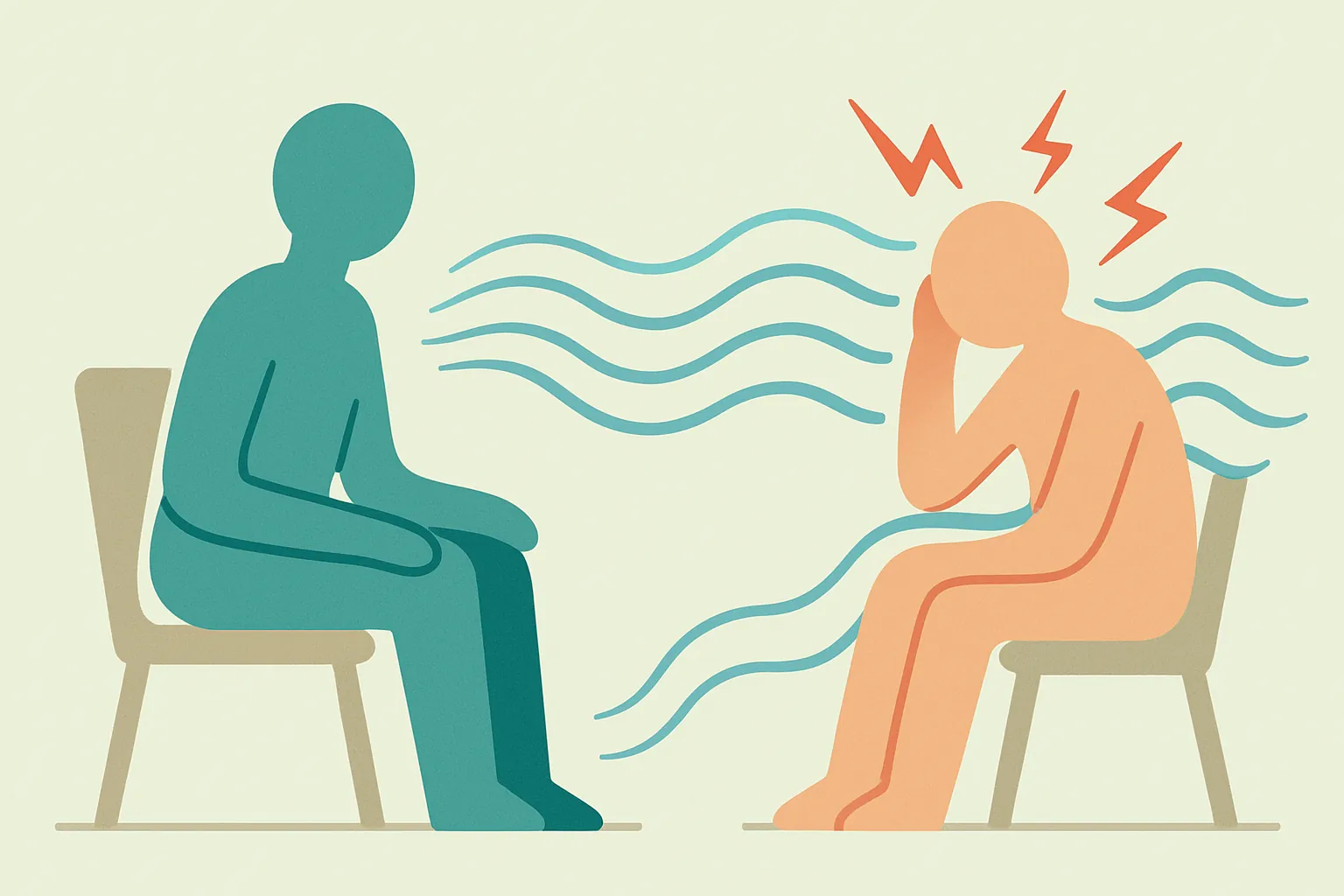
When a client arrives in acute anxiety, the prosody of your voice — its tone, pace, and rhythm — reaches their nervous system faster and more powerfully than the content of what you say. This reflects Stephen Porges's concept of neuroception in Polyvagal Theory: when the amygdala is flagging threat, even a well-crafted intervention fails to land. A warm, lower-pitched, melodic voice engages the vagus nerve and the parasympathetic system, while a slower speaking rate prompts deeper client breathing through mirror-neuron entrainment. In practice, pacing and leading — first matching the client's energy, then gradually slowing your tone and tempo — gives this physiological co-regulation a usable clinical framework.
Calming the Wave of Anxiety: How You Speak Decides Half the Work 🗣️
A client comes through the door breathing hard, pupils dilated, words tumbling out in a fast, scattered rush. What's your first move?
Most of us reach for content: we look for the cognitive distortion to gently challenge, or we reach for an empathic phrase. But neuroscience and contemporary clinical research point somewhere else first. For a client in acute anxiety, the strongest signal you send isn't your words — it's your prosody: the nonverbal music of tone, pace, and rhythm. Their nervous system reads your voice before it parses your meaning.
This aligns closely with the concept of neuroception in Stephen Porges's Polyvagal Theory. When a client's amygdala is registering "threat," no intervention — however well-crafted — actually reaches them. The channel is closed until the body feels safe.
And there's a second trap worth naming. Have you ever caught your own speech speeding up, your pitch climbing, as you absorb a client's anxiety? That's a form of countertransference, and it quietly destabilizes the working alliance. Your dysregulation becomes one more threat cue.
This article looks at how your voice becomes a physiological regulation tool — and exactly what tone and pace to hold to use it well.
1. Physiological Entrainment: The Voice That Changes a Brain 🧠
The core mechanism behind calming an anxious client is entrainment — the phenomenon, observed across physics and biology, where two rhythmic systems interacting will synchronize toward the stronger, more stable rhythm. In the room, your job is to make your nervous system the anchor: the steadier rhythm that the client's activated system can lock onto and settle into.
Engaging the Social Engagement System
The human brain evolved to read high-pitched, sharp sounds as alarm and lower, smoother prosody as safety. When you relax the muscles of your larynx and let your voice become calm and slightly melodic, you're stimulating the client's vagus nerve — lowering heart rate and shifting them toward parasympathetic activation. This is Porges's Social Engagement System coming online.
Mirror Neurons and the Transfer of Calm
Your steady breathing and slower speaking rate are unconsciously mirrored by the client through mirror-neuron activity. When you deliberately slow your tempo (pacing), the client tends to breathe more deeply in turn — and that produces an immediate drop in arousal. This isn't a vague "vibe"; it shows up in biofeedback data as measurable change in heart rate and respiration.
2. Anatomy of a Therapeutic Voice: What Escalates vs. What Soothes 📊
Not every "calm voice" works. A voice that's too flat and monotone can read as disconnection or indifference — the opposite of co-regulation. The skill is in knowing which vocal elements settle a nervous system and which inadvertently escalate it.
| Element | Escalates anxiety (avoid) 🚫 | Soothes the nervous system (apply) ✅ |
|---|---|---|
| Pace | Getting swept into the client's speed (150+ WPM) | Responding a half-beat slower, then easing the tempo down (100–120 WPM) |
| Pitch | High, sharp tone; rising question-like inflection | Steady, lower register; falling intonation at sentence ends to convey certainty and safety |
| Rhythm | Choppy, breathless, staccato delivery | Smooth, connected (legato) phrasing carried on the breath, with a slight melodic lift |
| Silence | Rushing to fill pauses with filler because the silence feels intolerable | Leaving 2–3 seconds between exchanges so the client has time to process |
Table 1 — Vocal elements and their effect on a client's nervous system.
3. In Practice: The Pacing-and-Leading Technique 🛠️
So how do you apply this in a live session? Slowing down indiscriminately isn't the answer — if you start too calm, the client can feel unmet, as though you don't grasp the urgency of what they're carrying. This is where pacing and leading becomes essential.
Step 1 — Pace: meet them first
Early in the session, when the client is reporting their anxiety fast and high, match their energy level but dial it down slightly. If their intensity is a 10, respond at a 7–8 in pace and tone: "This feels really urgent and frightening right now." That small offset signals, I'm tuned precisely to where you are — without amplifying the arousal.
Step 2 — Lead: slow the tempo gradually
Once rapport is forming and the client is attending to your voice, deliberately ease your tempo down — 6, then 5, then 4. Lengthen your sentences on the breath and open up the pauses between words. Something like, "Let's slow down… catch your breath… and try that again," uses nonverbal tempo to bring physiological arousal down with you.
Step 3 — Grounding: anchor the safety
As the client's breathing settles, move to a lower, steadier register (a grounded chest voice). Here the voice carries trust and quiet authority, delivering a message straight to the nervous system: this space is safe.
4. Pairing Clinical Skill with Better Data 🚀
Your voice isn't just a delivery channel — it's a therapeutic instrument in its own right. But monitoring your own tone and pace and tracking the client's response in real time, all at once, is genuinely hard. To stay fully present with a client's nonverbal cues, you have to reduce your own cognitive load. This is where modern AI tools earn their place in the room.
Automated documentation so you can stay present
With an anxious client, your attention should be on eye contact, on nodding, on tuning your voice — not on writing things down. Looking away to take notes, or the clatter of typing, can heighten a client's anxiety. An AI-assisted transcription tool lets you set the documentation burden down and put your attention entirely on the interaction and on tuning your voice.
Objective data for self-supervision
After the session, use the analyzed record to review your own interventions: Was I speaking too fast at that moment? Did I jump in too quickly when the client went quiet? Reviewing text and audio this way can be nearly as powerful for growth as formal supervision. Tools that go beyond accurate transcription — offering speaker separation and talk-time ratios — are especially useful for spotting and correcting unhelpful nonverbal habits.
If in-person supervision or peer consultation is available to you, pairing this kind of self-review with a colleague's outside perspective is the strongest combination of all. Modalia AI is built as a security-first partner for exactly this work — handling transcription, documentation, and case conceptualization support so your focus stays where it belongs.
Your voice is often the first channel through which an anxious client reconnects with the world. In your next session, consider setting the pen down and trusting the regulating power your voice already carries — and letting a capable AI assistant cover the gap. The longer we can hold a client's gaze, the deeper the work can go.
📝 Action items for this week
- Self-check: Recall your most anxious session recently. What was your speaking pace actually like?
- The three-second rule: Next session, after the client finishes speaking, deliberately hold three seconds of silence, then respond in a softer tone.
- Lighten the load: To cut documentation time and protect your clinical attention, try a security-first AI transcription tool that keeps you present with the client.
References
- 1.
Frequently asked questions
Why does my voice matter more than what I say with an anxious client?
When a client is in acute anxiety, their nervous system performs neuroception — an unconscious scan for safety or threat — before it processes language. Prosody (tone, pace, rhythm) reaches that system first. Until the body registers safety, even a well-formed verbal intervention won't fully land.
What speaking rate is most calming?
Aim for roughly 100–120 words per minute, noticeably slower than the 150+ WPM of an activated client. The key is not to match their speed at the outset, but to respond a half-beat slower and then ease the tempo down so they can entrain to your steadier rhythm.
What is pacing and leading?
It's a three-part approach: first pace the client by matching their energy slightly below their intensity so they feel understood; then lead by gradually slowing your tone and tempo; finally ground them with a lower, steadier register that signals safety. Starting too calm too fast can leave the client feeling unmet.
How can AI tools support this work without getting in the way?
AI-assisted transcription removes the need to take notes mid-session, freeing your attention for eye contact, breathing, and voice tuning — and avoiding the anxiety-raising distraction of typing. After the session, speaker-separation and talk-time analysis let you review your own pacing and silences as a form of self-supervision.
This article was written and reviewed using Modalia AI's clinical guidelines, with professional human review before publication.
Related articles
 Case Conceptualization
Breaking the "Yes, But" Game: A Transactional Analysis Guide for Therapists
Every suggestion you offer gets met with "Yes, but..." Here's the TA structure behind that stall—and four clinical moves to break it.
7 min read Case Conceptualization
Yalom's The Gift of Therapy: Passages Every New Counselor Should Copy by Hand
Irvin Yalom's prescription for therapists who fear silence: meet your client as a "fellow traveler" and let the here-and-now become the heart of the work.
6 min read Case Conceptualization
Working With Silence in Therapy: What Client Silence Means and How to Hold It
Silence in session isn't empty space. Learn to read its clinical meaning, tell productive from defensive silence, and use it as a therapeutic tool.
6 min read