Reading the Person Behind the Score: A Clinician's Guide to Wechsler Subtests (WISC-V & WAIS)
Go beyond the IQ number. Learn what each Wechsler index reveals about a client's anxiety, attention, and emotional state—plus a smarter way to capture process data.
Key takeaway
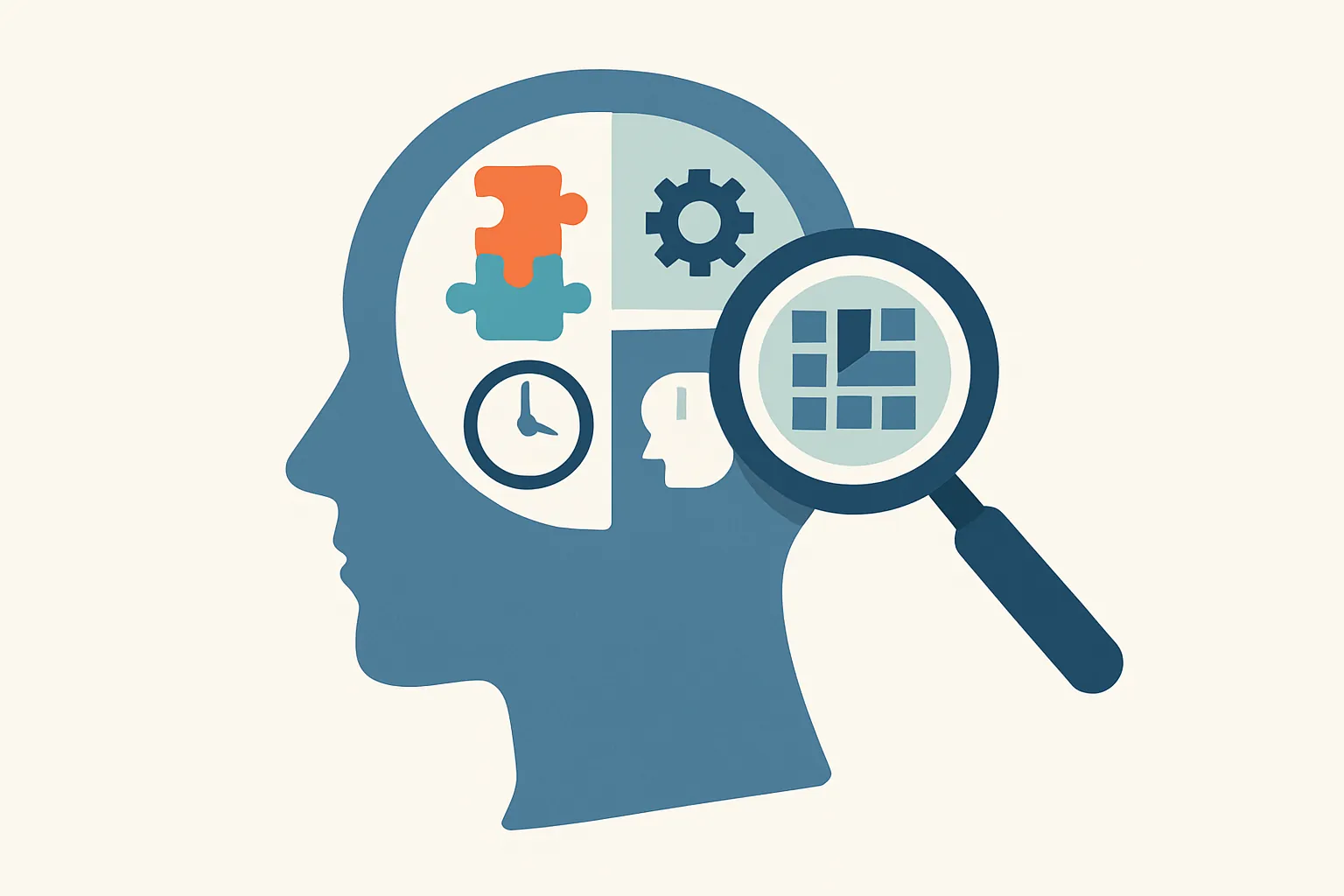
The Wechsler scales (WISC-V and WAIS-IV/WAIS-5) are not just IQ-generating instruments—the scatter between subtests offers a window into a client's cognitive style and emotional state. Discrepancies between Verbal Comprehension and Processing Speed often matter more than the Full Scale IQ: depressed working memory can signal ADHD or high anxiety, while slowed processing speed may reflect depression or perfectionism. Using a secure, consent-based AI transcription tool during testing lets clinicians offload verbatim note-taking and focus on observing performance behavior and nonverbal cues.
Beyond the Number: Reading the Client in the Wechsler Profile
In clinical work, we are often met with a deceptively simple question: "So, what's their IQ?" But for those of us trained in assessment, the Wechsler scales—the WISC-V for children and the WAIS-IV (now succeeded by the WAIS-5) for adults—are far more than a Full Scale IQ generator. They function as a cognitive map: a picture of how a client perceives the world, processes information, and solves problems under pressure.
What matters most is rarely the FSIQ itself. It's the scatter—the discrepancies between index scores and the clinical meaning hidden inside them. What is the lived reality behind the "stuck" feeling we sense in a client whose Verbal Comprehension is strong but whose Processing Speed lags far behind? How should we read the distractibility of a child with excellent perceptual reasoning but weak working memory? These imbalances are more than differences in ability. They reflect emotional state, anxiety level, and neuropsychological profile—and they are exactly the clinical signals that busy practitioners are most likely to miss.
This piece walks through the key interpretive points for each index and how to put them to work in real clinical reasoning.
A note on versions: The WAIS-5 (2024) is now the current adult edition in most English-speaking markets, though many clinicians and training programs still rely on the WAIS-IV. The index structure differs slightly between editions—WAIS-5 separates Visual Spatial and Fluid Reasoning much as the WISC-V does—so always confirm which form you're interpreting before comparing index scores against published clinical patterns.
1. Verbal Comprehension and Perceptual/Fluid Reasoning: The Content and Structure of Thought
The first step in mapping cognitive strengths and weaknesses is to weigh verbal ability against nonverbal ability. Together they show the primary channels through which a client takes in and works with information.
Verbal Comprehension (VCI): Crystallized Intelligence and Environment
The Verbal Comprehension Index reflects verbal concept formation, reasoning, and acquired knowledge—closely tied to crystallized intelligence, the store of skills and facts shaped by education and early environment.
- Similarities. Asking what two words have in common is a core test of abstract reasoning. Notice whether the client stays at the level of concrete features ("they both have a peel") or integrates toward an abstract category ("they're both fruit"). Low scores can point to concrete, rigid thinking.
- Vocabulary. Word knowledge is heavily influenced by education and early language exposure. High scores reflect intellectual curiosity—but clients with obsessive features sometimes over-explain, padding answers with excessive detail rather than precision.
- Information. This taps long-term memory and academic learning. When this subtest alone dips well below the others, consider limited educational opportunity or difficulty with long-term retrieval rather than a general verbal weakness.
Perceptual Reasoning, Visual Spatial, and Fluid Reasoning: Adapting and Problem-Solving
The WAIS-IV's Perceptual Reasoning Index—and the WISC-V/WAIS-5 split into Visual Spatial (VSI) and Fluid Reasoning (FRI)—measures the integration of visual information and nonverbal problem-solving. This domain represents fluid intelligence: the capacity to reason and adapt to novel situations.
- Block Design. This probes visual-motor coordination and spatial perception. Because it is timed, watch how the client performs under time pressure. Highly anxious clients may show hand tremor or a marked slowing of pace.
- Matrix Reasoning. Completing an incomplete pattern offers a relatively pure measure of inductive reasoning with minimal verbal demand—useful for estimating the potential of clients who struggle with verbal communication or come from a different linguistic or cultural background.
2. Working Memory and Processing Speed: Cognitive Efficiency and Emotional Sensitivity
For counselors and therapists, the two most clinically revealing indexes are Working Memory (WMI) and Processing Speed (PSI). They are decisive for detecting the bottlenecks that keep a client's true ability from showing up on paper.
Working Memory (WMI): A Gauge of Attention and Control
Working memory is the capacity to hold and manipulate information briefly in mind. A low score on Digit Span or Arithmetic is not simply "poor memory." It may indicate auditory attention deficits (as in ADHD)—but it can also be powerful evidence that high anxiety is consuming cognitive resources. When a client repeatedly asks you to restate the digits, or stumbles specifically on backward span, it often means internal interference—worry, intrusive thoughts—is crowding the working space.
Processing Speed (PSI): Mental Energy and Fine Motor Output
Processing speed—captured by Coding and Symbol Search—shows how quickly and efficiently the brain handles routine information. Clients with depression characteristically show reduced psychomotor speed, dragging this index down. Perfectionistic clients may also slow themselves, driven by a compulsion to avoid any error. This is why the score alone is never enough: watch the manner in which the client works.
| Index | Key Subtests | Hypotheses to rule out when scores drop | What to observe |
|---|---|---|---|
| Working Memory (WMI) | Digit Span, Arithmetic | • ADHD (inattention) • High state anxiety • Learning disorder (auditory processing) | Eye contact while listening to the item, number of restatement requests, self-talk |
| Processing Speed (PSI) | Coding, Symbol Search | • Major depression (psychomotor retardation) • Neurological or acquired brain injury • Obsessive perfectionism | Pencil pressure, time lost correcting mistakes, complaints of fatigue |
3. Accurate Records, Better Insight: Using AI Deliberately
In cognitive testing, the process matters as much as the score. On subtests like Similarities and Vocabulary, the client's exact wording determines scoring accuracy—the subtle line between a 0, 1, or 2—and is the raw material for qualitative analysis of how they think. Yet capturing a client's verbatim responses while simultaneously administering the test is a heavy load, even for seasoned clinicians. Bury yourself in note-taking and you'll miss the nonverbal gesture or the flicker of expression that often carries the most meaning.
Putting it into practice
- Automate the transcript. Counseling and assessment settings are increasingly adopting AI-based voice transcription. When a tool captures responses in real time, you can stop spending energy writing down response content and redirect it toward observing test-taking behavior. That frees you to catch the right moment to query an ambiguous Vocabulary answer instead of missing it.
- Integrate text with nonverbal cues. Beyond turning speech into text, AI can timestamp the length of a hesitant silence or a shift in speech rate on a charged topic. With this higher-resolution data, the qualitative-analysis section of your report becomes richer and more defensible.
- Choose ethical, secure tools—and get consent. Any technology used here must guarantee client privacy and data security; choose a professional solution built for clinical confidentiality. In the United States this means HIPAA-aligned handling and a signed authorization; in the EU/UK, an explicit GDPR lawful basis and informed consent. Recording carries special-category (health) data obligations—confirm storage location, retention, and processing terms before you press record. Done well, the consent conversation itself becomes part of rapport: a demonstration of transparency that builds trust.
In the end, the skilled clinician is not absorbed by the tool but uses it to meet the client more fully. The expertise to see through a tangle of subtest scores, combined with the breathing room that secure AI support provides, channels straight back into empathy and insight. How accurately does the protocol on your desk capture what your client is actually telling you? It may be time to listen in a new way.
Modalia AI is a security-first AI partner built for counselors and therapists—supporting session transcription, case conceptualization, and documentation while keeping client data protected.
References
- 1.
- 2.
Frequently asked questions
Why is the scatter between Wechsler index scores more useful than the Full Scale IQ?
The FSIQ is a single summary number, but the discrepancies between indexes show how cognition actually breaks down. A large gap between Verbal Comprehension and Processing Speed, for example, can flag emotional or neuropsychological factors—anxiety, depression, attentional difficulty—that a composite score averages away.
What can a low Working Memory Index suggest clinically?
A depressed WMI is not just weak memory. It may indicate ADHD-type inattention, an auditory-processing learning difficulty, or high state anxiety consuming cognitive resources. Behavioral cues—frequent requests to restate items, trouble with backward Digit Span—help you distinguish among these hypotheses.
Should I use the WAIS-IV or the WAIS-5?
The WAIS-5 (2024) is the current adult edition and is becoming standard, but many clinicians and programs still use the WAIS-IV. Index structures differ slightly between editions, so confirm which form you are administering before comparing scores against published clinical patterns.
Is it appropriate to use AI transcription during a cognitive assessment?
It can be, provided you use a secure, clinically appropriate tool and obtain informed consent—HIPAA-aligned authorization in the US, a documented GDPR lawful basis in the EU/UK. Used well, real-time transcription frees you from verbatim note-taking so you can observe performance behavior and nonverbal cues more closely.
This article was written and reviewed using Modalia AI's clinical guidelines, with professional human review before publication.
Related articles
 Case Conceptualization
Breaking the "Yes, But" Game: A Transactional Analysis Guide for Therapists
Every suggestion you offer gets met with "Yes, but..." Here's the TA structure behind that stall—and four clinical moves to break it.
7 min read Case Conceptualization
Yalom's The Gift of Therapy: Passages Every New Counselor Should Copy by Hand
Irvin Yalom's prescription for therapists who fear silence: meet your client as a "fellow traveler" and let the here-and-now become the heart of the work.
6 min read Case Conceptualization
Working With Silence in Therapy: What Client Silence Means and How to Hold It
Silence in session isn't empty space. Learn to read its clinical meaning, tell productive from defensive silence, and use it as a therapeutic tool.
6 min read