When WMI and PSI Differ by 20+ Points: A Hidden ADHD Signal on the WAIS-IV
A 20+ point split between Working Memory and Processing Speed on the WAIS-IV is rare—and clinically loud. Here's how to read it for ADHD.
Key takeaway
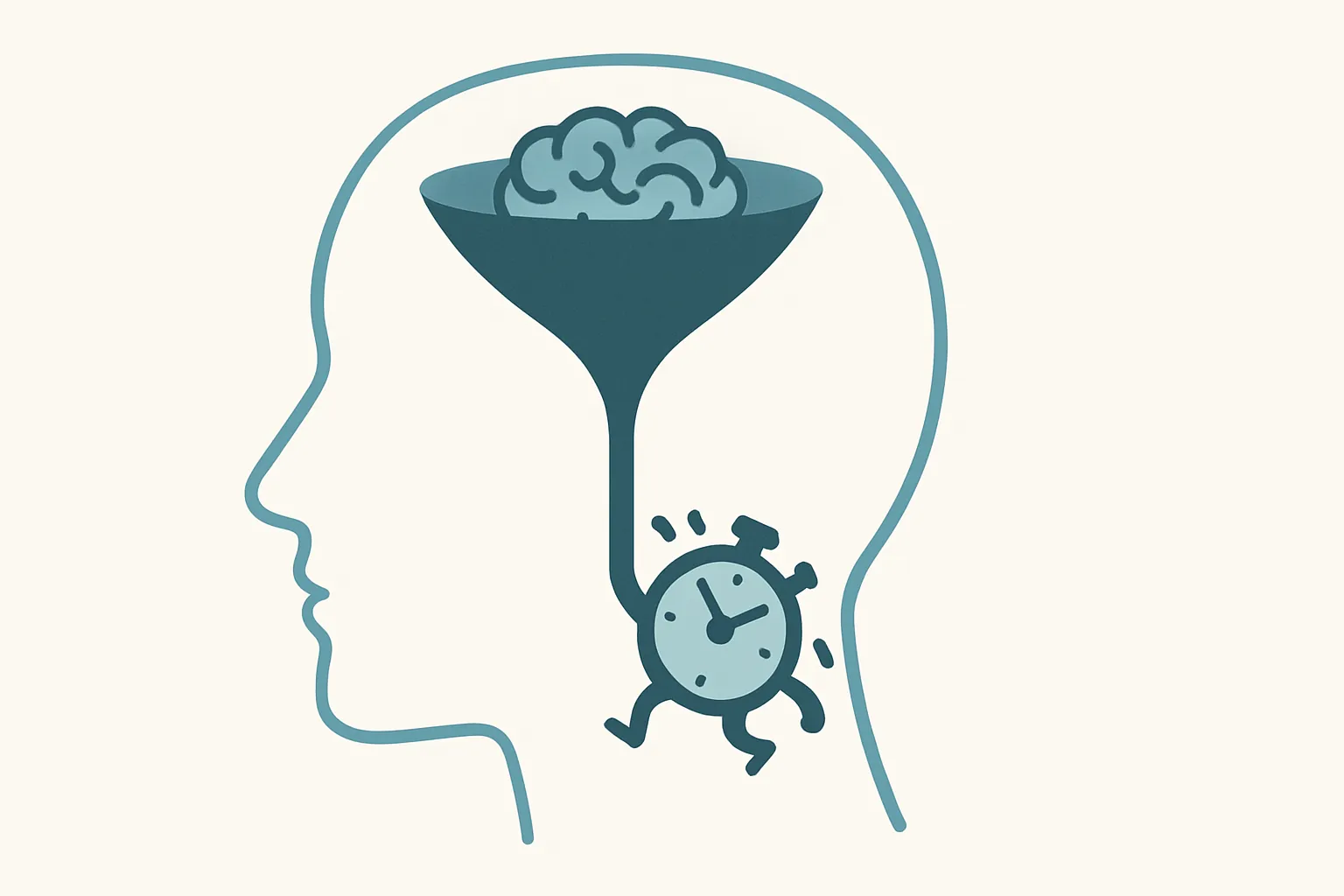
A gap of 20 or more points between the Working Memory Index (WMI) and the Processing Speed Index (PSI) on the WAIS-IV appears in fewer than 5–10% of the general population, making it a strong marker of cognitive inefficiency rather than ordinary individual variation. Because both indices load heavily onto executive function, this asymmetry warrants a careful ADHD workup: a high-WMI/low-PSI profile calls for differentiating inattentive ADHD from anxiety and perfectionism, while a high-PSI/low-WMI profile points toward hyperactive-impulsive presentations. The most reliable diagnostic leverage comes not from the scaled scores alone but from close observation of the client's verbal and nonverbal behavior during testing.
The WAIS-IV Interpretation Problem: Is a 20-Point WMI–PSI Gap Just Noise, or a Signal of ADHD?
When you sit with a set of WAIS-IV results, the number that pulls your eye is rarely the Full Scale IQ. It's the asymmetry between indices. And few patterns provoke more clinical hesitation than a 20-point-or-greater split between the Working Memory Index (WMI) and the Processing Speed Index (PSI).
This is the profile behind two of the most common questions clinicians ask themselves: "Why does someone this bright underperform so consistently?" and "Why are they so careless and scattered?" The answer often lives in the gap—in a breakdown of cognitive efficiency rather than cognitive capacity.
Adult ADHD is notoriously hard to diagnose precisely because its symptoms overlap with depression, anxiety, and temperament features like perfectionism. When a client says, "I just can't focus," that one sentence may be masking a serious bottleneck in how information is taken in, held, and acted upon. This article walks through what a WMI–PSI imbalance can tell you about ADHD, and how to differentiate and intervene clinically.
1. When Cognitive Efficiency Collapses: What a 20-Point Gap Is Warning You About
Statistically, a 20+ point discrepancy between indices occurs in fewer than roughly 5–10% of the population. It is uncommon enough that it points past ordinary individual difference toward genuine cognitive inefficiency.
Think of the two systems this way. Working memory is the mental workbench—the capacity to hold information in mind and manipulate it. Processing speed is the engine speed—how quickly and accurately simple, well-defined tasks get executed. Both are tightly bound to executive function, the core deficit domain in ADHD.
Why the imbalance matters
- The bottleneck effect. When one system is markedly weaker, overall performance levels down to the weaker capacity, no matter how strong the other is. Clients experience this as chronic, grinding frustration—"I know I'm capable of more."
- A marker of executive immaturity. Clients with frontal-system involvement frequently show WMI and PSI dropping below their Verbal Comprehension (VCI) and Perceptual Reasoning (PRI)—a "V-shaped" or "check-mark" profile across the four indices.
- A pathway to secondary emotional problems. A large gap keeps a person from realizing their own potential. Over time, that mismatch between ability and output becomes fertile ground for depression and anxiety.
2. Profile A: Strong Working Memory, Markedly Slower Processing Speed
This is the most common—and most frequently misread—presentation in the consulting room. The client grasps and retains complex information beautifully (high WMI) but can't move it into output at pace (low PSI). The result is a person mislabeled as a "lazy high-potential type" or simply "slow."
Clinical hypothesis: quiet (inattentive) ADHD vs. perfectionistic anxiety
These clients often don't look distractible. If anything, they look excessively careful. Here the differential is between inattentive-presentation ADHD (ADHD-I) and an anxiety/perfectionism picture.
Table 1 — Differentiating high-WMI / low-PSI profiles
| Dimension | Inattentive ADHD | Anxiety / Perfectionism |
|---|---|---|
| Source of slowing | A neurologically slow processing tempo (sluggish cognitive tempo) | Over-checking and compulsive verification driven by fear of error |
| Error pattern | Slow response times with unexpected omission errors | Few errors, but extreme response delay |
| Behavioral observation | Zoning out; forgetting and re-asking for instructions | Tense expression; repeated erasing; gripping the pen tightly |
| Presenting complaint | "I have all these ideas but can't get started." (executive initiation) | "I'm scared to start because I might not do it perfectly." (emotional paralysis) |
3. Profile B: Fast Processing Speed, Markedly Lower Working Memory
The reverse pattern: quick hands, but limited capacity to hold information in mind. This is the profile you'll often see in hyperactive-impulsive ADHD. Action outruns thought, which translates into frequent everyday mistakes and recurring interpersonal friction.
Clinical features and intervention strategy
- Impulsive information processing. These clients move fast on simple, automatic tasks like Coding and Symbol Search, but fall apart on tasks demanding auditory attention and mental control—Digit Span and Arithmetic.
- Difficulty following through. In session they answer before you've finished the question, or forget agreed-upon homework. This is not an intelligence problem; it is an absence of holding capacity.
- Therapeutic direction:
- Externalize memory. Because the client's brain won't hold the information, train the use of external aids—notes, recordings, alarms—as an "external hard drive."
- Visualize and segment instructions. Short, explicit, visual prompts beat elaborate verbal interventions.
4. Practical Recommendations for Clinicians
A 20+ point gap should never end at the feedback session. The clinical value lies in turning the number into intervention—closing the gap is where quality of life actually changes.
Action items
- Sharpen your behavioral observation. How a client performs tells you more than the scaled score. During processing-speed tasks, note whether they sigh, drop the pen, or read items aloud (an attempt to recruit auditory feedback to prop up working memory). Record these moments deliberately.
- Consider a referral for medication evaluation. If the cognitive imbalance is severe enough to impair daily functioning, coordinate with a psychiatrist. Stimulant and non-stimulant ADHD medications modulate dopamine and can help narrow the functional distance between WMI and PSI.
- Build metacognition. Explain the client's cognitive strengths and weaknesses plainly. A metaphor like, "You don't have a weak engine—you have a high-performance engine (your reasoning) paired with light brakes (your working memory), like a sports car," protects self-esteem and raises treatment motivation.
Conclusion: The Skill Is in Recording and Reading the Invisible Gap
On the WAIS-IV, a 20-point split between Working Memory and Processing Speed is not just a number. It's a map of the internal battle a client fights every day. The high-WMI/low-PSI bottleneck shows up as frustration; the low-WMI/high-PSI imbalance shows up as mistakes. Your job is to catch that signal, hold ADHD on the table as a hypothesis, and run a careful differential.
What matters most in that process is not missing the subtle verbal and nonverbal cues that surface during testing and in session. When a client mutters "oh, I lost it" mid-task, or stalls so they can have a question repeated, those moments are richer clinical data than the score itself.
This is one reason AI-assisted session-recording and transcription tools have drawn clinical interest. Technology that accurately captures speech rate, pauses, and fine nuance—and converts it to searchable text—helps you preserve the qualitative evidence of processing speed and working memory that memory alone tends to lose. Accurate documentation feeds accurate diagnosis, which is ultimately the foundation for choosing the right treatment plan for each client. Modalia AI is built for exactly this—a security-first AI partner for counselors that handles transcription, case conceptualization, and documentation so your attention stays on the client.
Go back through your case notes today and look again at clients with large index discrepancies. The key to understanding them may be hiding inside the gap.
Frequently asked questions
How large does the WMI–PSI difference need to be before it's clinically meaningful?
A discrepancy of roughly 20 points or more is uncommon, appearing in fewer than about 5–10% of the population, and signals genuine cognitive inefficiency rather than normal variation. Smaller gaps can still be meaningful in context, but a 20+ point split warrants a closer look at executive function and a possible ADHD workup.
Does a WMI–PSI gap by itself confirm ADHD?
No. The gap is a signal, not a diagnosis. It should prompt a structured differential—ruling in or out anxiety, perfectionism, mood disorders, and learning differences—supported by history, behavioral observation during testing, and standardized ADHD measures.
Which WAIS-IV subtests are most informative for this pattern?
Coding and Symbol Search drive Processing Speed; Digit Span and Arithmetic drive Working Memory. Comparing fast performance on the simple, automatic Processing Speed tasks against breakdowns on the attention- and control-heavy Working Memory tasks often clarifies the profile.
What should I document beyond the scaled scores?
Capture qualitative behavior: zoning out, omission errors, re-asking for instructions, sighing, erasing repeatedly, gripping the pen, or reading items aloud. These observations frequently carry more diagnostic weight than the numbers and are easy to lose if you rely on memory alone.
This article was written and reviewed using Modalia AI's clinical guidelines, with professional human review before publication.
Related articles
 Case Conceptualization
Breaking the "Yes, But" Game: A Transactional Analysis Guide for Therapists
Every suggestion you offer gets met with "Yes, but..." Here's the TA structure behind that stall—and four clinical moves to break it.
7 min read Case Conceptualization
Yalom's The Gift of Therapy: Passages Every New Counselor Should Copy by Hand
Irvin Yalom's prescription for therapists who fear silence: meet your client as a "fellow traveler" and let the here-and-now become the heart of the work.
6 min read Case Conceptualization
Working With Silence in Therapy: What Client Silence Means and How to Hold It
Silence in session isn't empty space. Learn to read its clinical meaning, tell productive from defensive silence, and use it as a therapeutic tool.
6 min read