Blog
Field insights, security, technology, and customer stories for counselors and therapists — all in one place.
 Case Conceptualization
Motivational Interviewing for Adolescent Addiction: Turning Resistance Into Change Talk
Why confrontation backfires with adolescent substance and gambling problems—and how MI's OARS and change-talk strategies help young clients voice their own reasons to change.
7 min read Case Conceptualization
"I Hate My Mother, but I Can't Let Go": An Object Relations Lens on Mother-Daughter Conflict and Separation-Individuation
How object relations theory reframes adult mother-daughter conflict—and three clinical strategies to support healthy separation-individuation without guilt.
7 min read Case Conceptualization
Do You Really Have to Memorize the DSM-5? The 5 Diagnoses You'll Actually Use Most
You don't need to memorize all 900 pages of the DSM-5. Here are the 5 diagnoses clinicians see most—and the differential questions that matter.
7 min read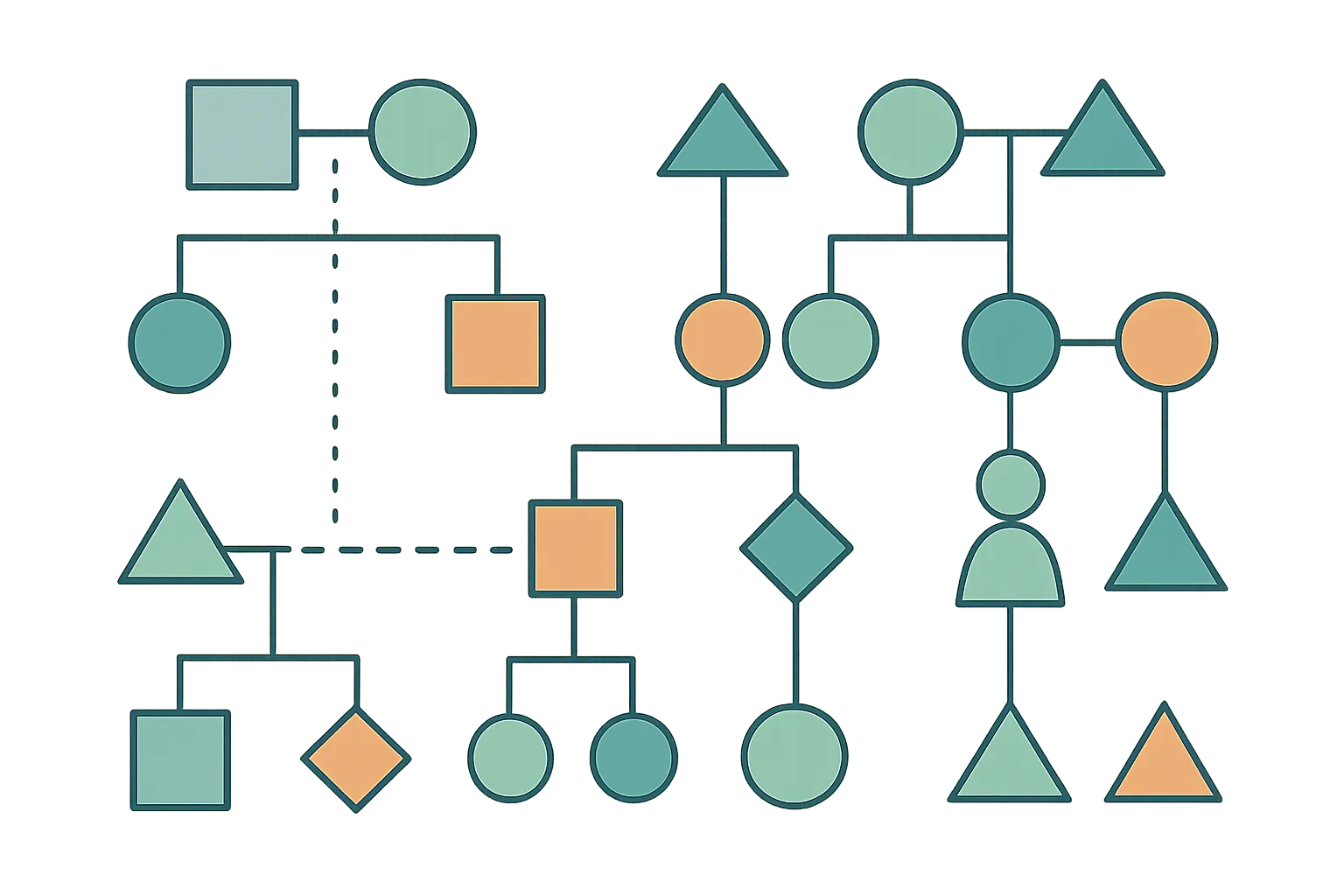 Case Conceptualization
Beyond Squares and Circles: Modernizing Genogram Symbols for Divorce, Blended, and LGBTQ+ Families
How to update genogram notation for divorce, remarriage, and LGBTQ+ and chosen families—plus a clinician's guide to expanded symbols that sharpen assessment.
7 min read Case Conceptualization
MMPI vs. TCI: How to Integrate Both for Sharper Case Conceptualization
MMPI and TCI measure fundamentally different dimensions. Learn how to cross-validate symptoms against temperament for a fuller, more actionable case formulation.
7 min read Case Conceptualization
When MMPI-2 and TCI Disagree: Reading the Gap Between Temperament and Symptoms
When MMPI-2 and TCI results point in opposite directions, the discrepancy isn't an error—it's a window into how your client manages their temperament.
4 min read Case Conceptualization
When MMPI and Rorschach Disagree: Reading Defense Mechanisms in Test Discrepancies
When self-report and projective findings conflict, the gap isn't an error—it's a map to the client's core defenses. Here's how to read it clinically.
7 min read Case Conceptualization
When Clients Reject Their MMPI Results: How to Turn Resistance Into Insight
A clinician's guide to handling client pushback during MMPI-2 feedback—three practical techniques that reframe resistance as a doorway to insight.
7 min read Case Conceptualization
Interpreting the MMPI-A: How It Differs From the Adult MMPI-2 and Why Adolescent Validity Scales Demand a Different Read
An elevated F scale on an adolescent's MMPI-A isn't always faking. Here's how to read validity patterns clinically and guide parents toward a developmental view.
7 min read Case Conceptualization
Setting Boundaries with MMPI 4-9/9-4 Clients: A Clinician's Guide to Impulsive, Antisocial Presentations
How to set firm therapeutic boundaries with MMPI 4-9/9-4 clients—managing impulsivity, manipulation, and countertransference without losing clinical authority.
6 min read Case Conceptualization
Reading Treatment Readiness from MMPI-2 Validity Scales (L, F, K)
Use MMPI-2 L, F, and K validity scale patterns to gauge a client's treatment readiness and match your intake interventions to their defenses.
6 min read Case Conceptualization
Reading Past Client Defenses: A Clinician's Guide to MMPI-2 Validity Scales (L, F, K)
How to interpret the L, F, and K validity scales on the MMPI-2—reading the configural patterns that reveal a client's defenses and the subjective intensity of their distress.
5 min read